
Your Custom Text Here
Michael Kerr meets Dervla Murphy
Once travellers shared opinions and experiences - now they queue silently to use a computer
Michael Kerr meets Dervla Murphy in a revealing interview for The Telegraph
In Wheels within Wheels, an autobiography published in 1979 that followed seven travel books, Dervla Murphy said: “One never writes anything of which one does not feel ashamed on seeing it in print.” Does she still feel that way, I asked her last week. “Oh, yes. I wouldn’t dream of reading anything I’ve written.” But surely, in her 84th year, she could look back on her 24 books and think that in one or two she came close to realising her intention…
She chewed a while on one of the olives the barmaid had set down with her pint of beer (her favourite tipple), and eventually said: “Probably Gaza and the new one, yes. And I think the Rwanda one.” Another pause. “In Rwanda, I found it possible to be not exactly neutral but less sort-of decisive than I am about the Palestinian situation.” It was the latest book, Between River and Sea: Encounters in Israel and Palestine, that had brought her to London from her home in Co Waterford, Ireland. Following the death this month from cancer of her son-in-law (to whom the book is dedicated), her publishers had told her she could be spared the publicity round, but she wanted to keep busy.
READ ARTICLE
Travel writer Dervla Murphy tells her most harrowing story
"Weeds," says Dervla Murphy in her deep, melodious voice, in what sounds like a mixture of mild irritation but also delight at the carpet of forget-me-nots covering the courtyard of the Old Market. This collection of stone buildings hidden away behind iron gates up a cobbled laneway in Lismore, County Waterford, is the home of the legendary Irish travel writer.
Dervla talks to Rosamund Burton of The Sydney Herald
"Weeds," says Dervla Murphy in her deep, melodious voice, in what sounds like a mixture of mild irritation but also delight at the carpet of forget-me-nots covering the courtyard of the Old Market. This collection of stone buildings hidden away behind iron gates up a cobbled laneway in Lismore, County Waterford, is the home of the legendary Irish travel writer.
Murphy has lit a fire in the main living area. It's not something she would usually dream of doing, she admits, even though the Old Market has no heating, but she has a guest staying. We don't linger in the warmth, but walk back across the courtyard to her study. While I wish I'd worn several more layers, Murphy is unfazed by the cold.
I first met Murphy with my parents in 1981, soon after we moved to Lismore, and it was the start of a long friendship. She and her daughter, Rachel, then lived in a bungalow on the outskirts of town. Much to my delight at the age of 18, Murphy dispatched me on her bicycle to Maddens Pub to buy her some beer. Not only did I share the name, Roz, with this bicycle, but also Murphy had cycled on it from Dunkirk to Delhi. Her first book, Full Tilt (1965), was about that journey, and the start of her travel writing career.
READ ARTICLE
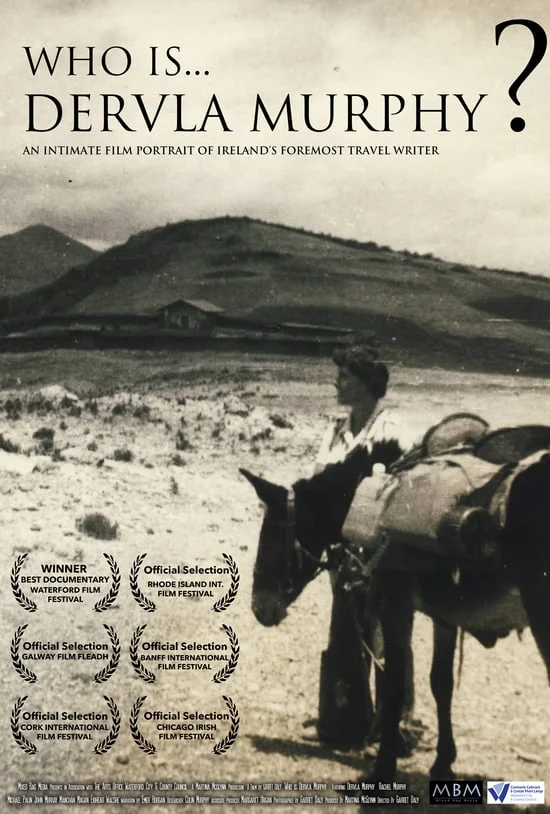
Who is Dervla Murphy?
If you're fearless, you have nothing to overcome . . .
By Mixed Bag Media
Dervla Murphy is Ireland’s most prolific travel writer who for five decades has travelled the world mostly alone, and mostly by bicycle. A fiercely independent woman who turned her back on societal conventions at a time when few were as brave, she observed and recorded the world with wonder and curiosity, and an astute political sensibility.
This special edition award winning documentary explores the woman behind the words in a fascinating film which shows her personal life to be as fascinating as her extensive journeys. The minutiae of life at home in Lismore and journeys abroad with her grandchildren provide an intimate backdrop to interviews with Dervla, her daughter Rachel, her publisher John Murray and fellow travel writers Michael Palin and Manchán Magan.
Officially selected for The Galway Film Fleadh, Cork International Film Festival, Rhode Island Film Festival and Banff Film Festival. Also winner of The Waterford Film Festival for Best Documentary.
The Book Programme, BBC Radio Ulster
Dervla Murphy discusses her career writing about travel
Dervla Murphy discusses her career writing about travel on The Book Programme.
Full Tilting Interview
In 1977, in her astonishing account of a winter spent with her six year old daughter in the sub-zero Indus Valley in Baltistan, Dervla Murphy declared that she had ‘no head for politics’. In ‘A Month By the Sea: Encounters in Gaza’, her no less astonishing new book, it is abundantly clear that much has changed on that front in the ensuing 35 years, and readers of Dervla’s recent books may rather suspect that her claim made in Baltistan may well have been a case of modesty over accuracy.
In 1977, in her astonishing account of a winter spent with her six year old daughter in the sub-zero Indus Valley in Baltistan, Dervla Murphy declared that she had ‘no head for politics’. In ‘A Month By the Sea: Encounters in Gaza’, her no less astonishing new book, it is abundantly clear that much has changed on that front in the ensuing 35 years, and readers of Dervla’s recent books may rather suspect that her claim made in Baltistan may well have been a case of modesty over accuracy.
‘A Month by the Sea’ - the eagerly awaited first of two books to be published on her time in Israel and Palestine recalls the month Dervla spent in Gaza during the summer of 2011, and paints a pen portrait of day to day life for the residents of Gaza, as they navigate ordinary lives in uniquely un-ordinary geopolitical surroundings. Empathetic and honest, ‘A Month by the Sea’ makes a great impact, and owes its success in this to the way in which Dervla has combined her classic travel narrative, focusing characteristically on the day to day lives and stories of the people she encounters, with her frank and meticulously researched political writing. This hybrid approach has produced a book in which complex political situations are elucidated, and the impacts of those situations on the ordinary people of Gaza are starkly illuminated through heartfelt portraits of the people she meets and the friends she makes, too intimate and raw to be classed as mere case studies.
Originally intended to form two chapters in one book about the region, the account quickly grew into a book of its own, and in terms of the contribution the book makes to popular understanding of the complexities of life on the blockaded Gaza strip, it is easy both to see why Dervla Murphy was unable or unwilling to curtail her report, and to understand that this bold, empathetic and unapologetically human book is a valuable piece which deserves a wide readership.
Coming fifty years after Dervla Murphy embarked on the bicycle journey from Ireland to India which would be recounted in her classic ‘Full Tilt’, ‘A Month by the Sea’ was released in February 2013 by Eland, and FullTilting spoke to Dervla Murphy about how she felt about the book’s publication, and asked her what it was like to look back over five decades of sharing her experiences of the world with her readers.
FT: Are you excited about the new book? How do you feel now the journeying is finished and it’s at publication?
DM: Well I suppose I’m about three quarters of the way through the much more difficult, longer book, so I’m not really thinking about Gaza and its coming out next month! I’m completely focused on getting the other one finished!
FT: When you went out originally it was with the intention of writing the one book with a couple of chapters on Gaza, but it’s grown into a book of its own. Was that a natural process or was it important to you that it developed that way?
DM: When I came back from Gaza I said to myself ‘Now, while the material is all so fresh in my mind I’ll do these two chapters and then finish the other one and tack them on at the end’ And then, blow me down, didn’t the two grow into nine! My publishers, Eland, said this was a book on its own.
FT: Was it important to you that the stories of the people you met were given that full coverage in a book of their own? Were you happy that it grew?
DM: Yes – I realised that Gaza is obviously sharing the handicaps of most of the Palestinians on the West Bank and in the Occupied Territories but their situation, as you know, is quite distinct – worse- than the others, and I did feel that it deserved attention on its own, rather than be merged in with the rest.
FT: Reading the book, it feels to the reader as though your motivation for writing this one wasdifferent to some of your other books – that it’s perhaps more overtly activist – is that something you’d agree with?
DM: Oh yes, you’re absolutely right.
FT: And presumably you’re trying to raise awareness rather than just report?
DM: You know, I was really amazed to find that so many of my friends, normally, well informed people, were so ignorant of the Palestinian situation. There are hundreds, probably thousands of really good books about the situation, and there’s no reason why people shouldn’t read them, but somehow they seem not to. And it was a Palestinian friend of mine, when I was at the end of my second visit, before I went back for the third time – I said to him ‘Is there any point [in writing my book]? I’ve spent four months here now and I’ve lived right in the middle of it all, but I actually have nothing new to say that hasn’t been said already, probably better than I could say it, and it’s out there in excellent books.’ And he said ‘But there’s a chance that if you write it, people who read your travel books, your other books, will read it, though they might not buy a book just because it was about Palestine’, and that is actually what made me decide to write it.
FT: Sometimes in the media, the effects of war on ordinary people can almost become normalised, yet what appealed to me in your book was the way that you were talking about real people that you’d met, that you knew, that you cared about – so in that way they got names, they got backgrounds, and they were not just a statistic on a page. Was it important to you to tell their stories as individuals?
DM: Yes. There’s no doubt that the mainstream media is very, very ambivalent in their coverage of the whole Palestine-Israel thing. I was given an absolutely fascinating essay by a psychiatrist called Martin Kemp and he has been out looking at the whole situation there from his own perspective – and I’ve carefully read over 200 books - but this one essay, to me, is more useful to explain the appalling difficulties – the whole political situation, why is it so?
FT: You mention at various points in your book that the situation in Gaza is very much a political rather than a humanitarian crisis, and the people you meet are very clear about that. Could you say any more about that distinction in terms of how it affects the way the people in Gaza mobilise themselves?
DM: Well of course they can’t really mobilise themselves at the moment – it’s an unbelievable situation actually when you think of it – they cannot leave.
FT: Indeed your own description of the difficulties you had in trying to leave Gaza yourself seemed perhaps to give an insight into the frustrations, just for those 24 hours, of the people there?
DM: Exactly – and that is their way of life. But I think that distinction [between political and humanitarian] is so important. I get various appeals now from medical and humanitarian groups, generally, and I do contribute but I’m beginning to wonder if there’s any point. Because this is not what they are asking for – they’re not asking for free food or free medicine – they’re asking for freedom.
FT: And that I suppose is the tragedy of the situation. I don’t know if you’ve seen in the news recently, but Oxfam have begun to say that traditional aid to Africa, for example, in terms of ordinary people giving money in response to ‘famine appeals’, for example, is not always the right approach, and there’s a general feeling that certainly ‘pitying’ giving is not always right because it deprives people in some ways of their equality, and their dignity.
DM: That’s right, I saw that and I think in some of my books, the African ones, I think I have mentioned that – we can actually do much more harm than good by indiscriminate humanitarian aid. But what they really need is for the capitalist West to get off their backs and let them make their own living, off their own land.
FT: You make a lot of reference in the book, which is very heartening, to ‘samoud’ – the positivity of the Gazans.
DM: Oh yes it’s extraordinary!
FT: Was that surprising to you, that people could retain such positivity?
DM: Well, I mean I’d been living with it for months on the West Bank, so I was familiar with it. What did astound me was that even in the conditions of life in Gaza, that it could survive there.
FT: Do you think it’s important to the survival, then, of the Gazan people, in terms of their mental health?
DM: Oh absolutely yes.
FT: Your books have become increasingly political over the last couple of decades. Did you ever consider that you might go into politics yourself?
DM: Oh God no! I wouldn’t want to be mixing with that lot!
FT: You are famously not a fan of mobile technology or the internet, but there are little hints in the new book that you had a mobile phone, and would send some emails. Are your views changing at all, or was it simply the necessity of the situation?
DM: Oh no, that was just in Gaza, I had absolutely no choice. I’ve never used a mobile phone since! I mean, I can appreciate of course how useful a mobile phone can be, and in fact I had one too on the West Bank because there are no landlines, but if I were to use one habitually, and have my mobile number all over the place, I would hate the feeling that I was all the time accessible.
FT: What about blogs? Is posting pictures and diary updates from your travels something you might do now if you were just starting out?
DM: Definitely not! In the long book I’m writing, I remark that when I got to Jaffa I was staying in a very cheap backpackers’ hostel, but with all different age groups –I wasn’t the only oldie, there were quite a few other white hairs, but otherwise it was the normal backpackers crowd. It was a lovely old 18th Century building, quite close to the shore, with a huge common room, and in the old days, before all this technology, everybody in the evening would have been talking to one everybody and exchanging experiences, addresses, advice, but now instead of that they were lined up on their computers, communicating with people at home, instead of being with their fellow travellers. Even though these new methods of communication are supposed to widen their world, it seems to me as though they’re narrowing their world –speaking to friends and relatives through their computers instead of speaking to people who are physically present.
FT: If you were thirty something and starting out on your travels today, what sort of things do you think you might be doing? What kind of journeys might you be taking?
DM: Gosh it would be much more difficult wouldn’t it, from my point of view? Because if you think of my favourite places, when I was travelling through them, they were free of motor roads. Not the Full Tilt trip, but the mountain journeys, Peru and so on, you could get away so easily from the motor roads.
FT: And I suppose that’s almost impossible now?
DM: Yes
FT: For me, and I am sure many people, the appeal of reading about your journeys is that you have an ability to make remote places and lives seem very familiar. Have you intentionally focused on the ‘day to day’ in your writing?
DM: Well I suppose I have, because the books are based on the journals that I kept every evening, so that naturally follows, if those are the basis, the framework for a book.
FT: Is there any sense that you were intentionally trying to convey equality between people by highlighting similarities, no matter how remote, or do you think that’s an unintentional outcome?
DM: I think unintentional.
FT: And as well as describing the people you meet, it seems as though the physical environments and the landscapes have been at least as significant and interesting to you?
DM: Absolutely, very much so yes.
FT: You have written as well that your own home town Lismore and the River Blackwater are clearly of massive significance to you – do you think nowadays that the notion of a ‘place of origin’ is becoming less important to people as families disperse?
DM: I expect so. I think there are probably very few people now actually, in the younger generations, who are fortunate enough to be able to keep a base where they were born and feel absolutely rooted there. So I think I’m very, very lucky, and I’m grateful for the good fortune. But I suppose in a world where people do move around so much, the younger generation aren’t going to miss what they’ve never had – it’s not going to be important to them to be rooted in any particular place.
FT: Coming back to travelling, something which is very popular now is organised homestays – what do you make of them?
DM: I think they’re a really good idea.
FT: They seem to give a version of what you were able to experience but there must be the question of whether the transactional aspect devalues them?
DM: That’s inevitable, but I agree that the positives outweigh the negatives. The places where I went, at the time when I went, there was really just me, or maybe me and Rachel, and people were so generously hospitable, but you couldn’t expect that to be maintained when there are streams of people passing through a place.
FT: It’s fifty years now, not since 'Full Tilt' was published, but since you set off on that journey – how does that feel?
DM: Well until you reminded me I’d forgotten all about it!
FT: Do you feel like you’ve changed as a person since then? Or in what ways are you the same?
DM: I would say essentially, probably, I’m the same. Obviously over fifty years everybody changes, but I don’t think that I’ve fundamentally changed as a personality. I’ve become much more activist, though, over the last couple of decades, and the books have changed, so in that sense I’ve changed – taking more interest in social problems, and also getting more and more angry about the damage that’s done. Especially when I hear people talk about corruption in Africa – when you think of how the various imperial powers left Africa, they left having already made corrupt deals and arrangements with the rulers in most cases, so that even though colonialists were withdrawing they were still able to profit from the countries, in collusion with the leaders, and now we hear those leaders or their successors condemned for being corrupt. That corruption in Africa was set up by us.
FT: Looking back over your fifty years, there must be some experiences which really stand out to you as defining moments along your personal journey? Any places you go back to in your mind?
DM: I suppose the Andes, and the Simien mountains, and the Karakoram. Lots in other words.
FT: And was there ever any moment during the course of your life or your travels where you thought ‘no more, enough, I’m hanging up my backpack’?
DM: Never.
FT: What about future travels? Any plans?
DM: At 81 you can’t be making long term plans! But I always try while I’m still writing a book not to think about the next travels, it’d be too distracting.
FT: Do your granddaughters have ambitions to travel or write?
DM: They seem to be more on the musical side, very keen on music and practising. I’m sure they would like to travel but I don’t know, there are so few places left where they could go and have the sort of remote experience that I had. It is, I’m afraid, not possible.
Desert Island Discs - 1993
Sue Lawley's castaway is cyclist and writer Dervla Murphy.
Sue Lawley's castaway is cyclist and writer Dervla Murphy.
Favourite track: Triple Concerto in C Major by Ludwig van Beethoven
Book: Diary by Samuel Pepys
Luxury: A still (to distill berries, etc. into drink)
Three Tibetans in Ireland
On a cold grey day at the end of March 1964, shortly after my return from India, I first met a Tibetan in Western surroundings – the foyer of a central London hotel. I had been working for some months in Dharamsala, then an overcrowded and under-funded refugee camp for Tibetan children, and that moving encounter with the Tibetan way of being made me feel slightly apprehensive about Lobsang. How would this young man, only five years out of Tibet and three months out of India, be reacting to our Western ways?
This is the piece that Dervla Murphy wrote for OX-TRAVELS, published in 2011 by Profile Books, which contains three dozen stories of MEETINGS OF REMARKABLE TRAVEL WRITERS, all royalties were pledged by all the writers to the coffers of Oxfam.
I
On a cold grey day at the end of March 1964, shortly after my return from India, I first met a Tibetan in Western surroundings – the foyer of a central London hotel. I had been working for some months in Dharamsala, then an overcrowded and under-funded refugee camp for Tibetan children, and that moving encounter with the Tibetan way of being made me feel slightly apprehensive about Lobsang. How would this young man, only five years out of Tibet and three months out of India, be reacting to our Western ways? But I needn’t have worried; by the time our refugee-elated business had been concluded I knew that Lobsang was in no danger of being ‘tainted’ – he was simply adjusting to his new circumstances to the extent required by good manners.
As we walked through St James’s Park my companion explained his background. The second youngest of eight children, he was born in 1943 in Lhasa where his civil servant father practised as an oracle. Only in retrospect can one fully appreciate the uniqueness of Lobsang’s generation of Tibetans. Born the son of a government oracle, he is now the grandfather of an IT-savvy seven-year-old.
In 1945 Lobsang was orphaned and two years later adopted by his father’s brother, an austere uncle, an Incarnate Lama of the Gelugpas who had founded two monasteries. At one of these – Tubung Churbu, twenty miles west of Lhasa – Lobsang spent his school holidays in a small community of a hundred monks, some of whom were his contemporaries. Although one can’t have an informally relaxed relationship with an Incarnate Lama, his Abbot uncle’s unspoken affection comforted him. During term time a warmhearted Lhasa aunt mothered him and three of his brothers.
When the Lhasa Uprising began in March 1959 Lobsang’s only sister (a pioneering agronomist) was murdered by the Chinese and he fled to Tubung Churbu; his family was sufficiently prominent for every member to be at risk. The monks were preparing to follow the Dalai Lama to India and two weeks later the Abbot set out with twenty-five young lamas, his sixteen-year-old nephew and a train of sixty mules carrying a library of ancient Sanskrit manuscripts and a famous collection of t’ankas [traditional Tibetan Buddhist paintings on silk scrolls]. To avoid the Chinese, refugee caravans used perilous passes over high mountains and this comparatively short journey took more than three months. Half the mules were lost through injury. Lobsang and his friends suffered acutely from loneliness and grief; they already sensed that their exile would be permanent. He described himself as ‘caught between two fears’. Would the Chinese successfully pursue them? And what awaited him at journey’s end? He spoke only Tibetan and a little Chinese and could not begin to imagine the world beyond the mountains. He was then unaware of the significance of money; always his needs had been provided for yet soon he was to be unsupported …
But not immediately: at Kalimpong Uncle arranged for his nephew to lodge with Sherpa Tenzing of Everest during the monsoon, while learning Nepali, Hindi and English. The Abbot continued to Benares where he was soon to hold the chair of Sanskrit Studies at the Hindu University. His t’anka collection had survived the journey and a year later formed one of the main attractions at Delhi’s International Exhibition of Oriental Art.
In November Tenzing helped Lobsang find a job as houseboy to an expat family – an unremarkable move by our standards, but in Tibet this youth had been attended by personal servants who wouldn’t allow him to put on his own boots. At this stage he found himself being scornfully regarded, in some refugee circles, as too naïve to make the most of his connections. In fact he wished to equip himself with some means of helping the tens of thousands of illiterate Tibetans then drifting about northern India in bewildered misery. After nine months he had saved up enough to leave the Americans (despite their offer to double his wages) and become a voluntary worker at Mrs Bedi’s School for Young Lamas. There Joyce Pearce of The Ockenden Venture discerned his capabilities and offered him the opportunity to help settle orphans in European homes, which is what brought him to London.
Before we said goodbye at Waterloo station Lobsang had accepted my invitation to spend his summer holiday in Ireland, on the smallest of the three Aran Islands.
In the 1960s Inisheer’s only roads were narrow dirt tracks, the traffic consisted entirely of donkeys, water was drawn from wells, clothes were homespun, everyone spoke Irish – and there two of my books were written by candlelight. It seemed to me that a Tibetan would find himself at ease on Inisheer, an intuition soon confirmed by Lobsang.
Our two and a half hour steamer journey from Galway, on a cloudless August morning, was Lobsang’s longest sea voyage. When we anchored, a fleet of currachs – frail little craft of wood-lathe and tarred canvas – immediately surrounded us to ferry passengers and goods ashore. Boat-days were then quite an event for the 280 or so islanders and inevitably Lobsang’s arrival provoked uninhibited curiosity. This slightly discomfited me but afterwards it transpired that the refugee had observed a family weeping as they said goodbye to an emigrant daughter and had been more aware of this sad feature of Inisheer life than of his own conspicuousness.
For three weeks we shared a friend’s cottage (Daphne was the only outsider living permanently on the island), washing at the well three-quarters of a mile away, cooking over an open turf fire and sleeping on the floor. Lobsang enthusiastically took on many of the daily chores and had soon dug a splendid latrine for use with turf ash. He also volunteered to collect dung to supplement our expensive imported turf but here ethical complications arose; cowpats containing insects were ineligible for burning. Observing this, Daphne and I discreetly abandoned forays to collect barnacles and periwinkles.
After sunset we sat around the glowing hearth and returned to Tibet with Lobsang. He had seen more of his own country than most non-nomadic Tibetans. In 1956 Uncle had taken him on an eighteen-months’ journey to a sacred mountain in west Tibet. This pilgrimage of a Very High Lama to a Very Sacred Mountain generated a caravan of 100 horses and mules and 300 yaks, carrying camping equipment and stores for sixty monks and servants. West Tibet’s barrenness made it necessary to carry so much food – mainly tsampa [roasted flour], cheese, dried meat and compressed vegetables, plus emergency fodder for the animals.
At nightfall everyone but the Abbot helped set up camp – excellent training, Lobsang remarked, for him and his otherwise pampered young companions (all fledgling lamas). Several flooded rivers had to be forded, the equines swimming through the swift icy water, the yaks being ferried on square, flat-bottomed boats of wood and yak-hide. Excitements were few- a panther killing a dog, or hundreds of wild horses galloping across the steppes. Recalling that happy and peaceful journey, Lobsang had to pause occasionally to control his emotions. Already he realised that even as we spoke Buddhist Tibet was being changed forever. From him I learned that the sudden violent dispossession prompting a refugee flight is peculiarly traumatic. Apart from the loss of a settled home and traditional occupation, and separation from close friends and familiar places, it is the death of the person one has become in a particular context. Three years after our Inisheer interlude, Lobsang noted: ‘Every refugee must be his or her own midwife at the painful process of rebirth’.
II
By May 1965 I was back with the Tibetans, running a children’s feeding programme in Pokhara’s refugee camp, overlooked by Machhapuchhare. On 12 May, as I walked between ragged cotton tents, occupied by recently arrived nomads from west Tibet, piercing squeaks drew my attention to an object lying on the palm of Ngwanag Pema’s hand. It was very small, very black and very vocal. Moments later I had exchanged the equivalent of ten-and-sixpence (50 pence in new money) for a twelve-day-old Tibetan bitch to be delivered once she was weaned. I wondered what the astrologists would make of the coincidence that this pup and I had entered Nepal on the same date: 1 May.
Six weeks later Tashi moved in to my mud-floored room in the bazaar and I took time off to help this refugee adjust to her new environment. All afternoon she lay on my lap while I wrote but hours passed before her look of puzzled distress began to fade. Then at last she wagged her tail – a brief and doubtful wag, but a wag’s a wag for all that and this sign of dawning trust enchanted me. A night of unmothered whimpering would have been understandable yet Tashi slept soundly, curled up on my stomach. As she was much too young to be left alone I carried her everywhere, for the next month or so, in a cloth shoulder-bag.
By mid-September Tashi’s furry cuddlesomeness had been replaced by a silky strokability. Her build was distinctive; one tactless Irish friend was to describe her as ‘a stocking left too long on the needles’. Her black coat had elegantly symmetrical white and tan markings and her admittedly ridiculous brown feathery tail curled up and over her back. Several schools of thought debated the delicate question of her breed. A local ‘expert’ pronounced her to be a smooth-haired Tibetan terrier which was absurd; but Ngawang Pema – hoping to sell the next litter to foreign visitors – agreed with him. An Indian UN official, who himself bred Afghan hounds, defined her as a Miniature Himalayan Sheepdog – a theory reinforced by Ngawang Pema’s occupation. Personally I regarded her as a perfectly good Tibetan mongrel or pi-dog. However, anyone besotted enough to go to the immense inconvenience and expense of transporting a dog from Nepal to Ireland must be tempted to pretend, as a face-saving device, that the import belongs to some rare Central Asian breed of enormous snob-value. Therefore the form I filled in on 15 September, to begin the arduous process of obtaining Irish citizenship for Tashi, boldly proclaimed her to be a Miniature Himalayan Sheepdog.
A week previously I had informed the Irish embassy in Delhi that on 3 December I planned to land in Dublin with a Nepal-born dog. In reply came a parcel of lengthy documents making it plain that Ireland’s Department of Agriculture is allergic to alien quadrupeds. One could visualise the thin-lipped bureaucrat who had devised all these regulations to wither any imprudent relationships cultivated by expats. Reading them hardened my determination to ‘import a domestic pet of the canine species into the State from a place abroad…separately confined in a suitable hamper, crate, box or other receptabcle which must be nose and paw proof and not contain any hay, straw or peat-moss litter’. Impatiently I completed the preliminary forms and wrote letters to ‘the approved quarantine premises’ and ‘the approved carrying agents’ while Tashi lay happily by my feet unaware that during the next few months a lot of people were going to make a very big fuss about a very little dog.
Throughout October and November all my ‘reminding’ letters to the Irish Embassy in Delhi and the Department of Agriculture in Dublin were ignored. By 26 November Tashi’s entry-permit should have been awaiting me in Kathmandu but it wasn’t. From there I sent many frantic cables to Delhi and Dublin, Tashi accompanying me every morning to the new ‘Indian aid’ Telephone and Telegraph office. While I drafted progressively less polite messages the staff eyed my companion derisively and commented on the unusual brand of lunacy revealed by the compulsion to import such an object to Ireland. After four days of impoverishing communications I ended my campaign defiantly; at 3.20 pm on 3rd December a black and-tan bitch from Nepal would land at Dublin airport with or without her visa which had been applied for on 15 September.
In Delhi we stayed with friends for a few days while Tashi received and recovered from numerous inoculations. At once she displayed characteristic Tibetan adaptability, both to her new surroundings and her new friends. In a bazaar near the Red Fort I bought the statutory ‘nose- and paw-proof’ basket which is still in use almost half a century later as a bathroom laundry basket. On the eve of our departure I cunningly took Tashi to Air India’s central office and introduced her to the Authorities. Nothing else was necessary; they immediately agreed that it would be superfluous to imprison such a very small passenger between Delhi and London. Moreover, it could easily be arranged to have an empty seat beside mine. And so it came about that Tashi, conceived in western Tibet and born in a nomad’s tent at the base of Machhapuchhare, now had the run of a Boeing 707. From where we are in 2011, it’s hard to believe that once upon a time air travel was easy-going.
At Beirut Tashi expressed the need for a grassy spot – and promptly disappeared into the darkness of the night. As engine trouble in Bombay had already delayed us by three hours the captain asked the passengers if they would be kind enough to forgive another delay – this time a short one – while Miss Murphy pursued her puppy. Ten stressful minutes later I was stumbling into the cabin clutching a trembling Tashi who apparently hadn’t much liked what she’d seen of the Lebanon.
At Prague I chained her, lest she might have anti-Communist prejudices, and at London – feeling traitorous – I roped her in her basket and delivered her to the waiting RSPCA van. When she had been handed over to an Aer Lingus official he ruthlessly consigned her to the terrors of the hold, ignoring my pleas that she should be allowed to travel in her basket on my lap.
The scene at Dublin airport was surreal. My final defiant cable had activated a platoon of uniformed officials who were falling over each other in their anxiety to ensure that the infinitesimal Tashi did not break loose and overnight turn the nation rabid. A grotesquely large covered truck stood waiting to transport the mini-basket to the State Quarantine Kennels ten miles away and to my fury I was refused permission to accompany Tashi through the alien cold wetness of an Irish winter night.
Next morning I found that the kennels were exceptionally well run and during her six months’ isolation Tashi remained in perfect condition and grew a little more. Although my regular fortnightly visits delighted her she accepted my departures with composure – and at last came the day when she departed too, into breezy green fields and bright June sunshine. The joy she then showed at racing free can have been no greater than my own on seeing that little black body again unfurling its ridiculous brown tail in the wind.
III
Tashi was aged three and a half when Rinchen Dolma Taring came to stay with me in Ireland while writing her autobiography. (Daughter of Tibet: Kohn Murray, 1970; Wisdom Publications, London, 1986.) His holiness the Dalai Lama had given Amala four months leave from her job as Director of Mussoorie Children’s Homes. Time being so limited, we lived in isolation, working twelve hours a day with only one day off in February 1969, to celebrate Losar, the Tibetan New Year.
My role was not to ghost Amala’s book but to give editorial advice – a much slower process – and I soon realised that a Buddhist’s autobiography is a contradiction in terms if the writer is as ‘advanced’ as Amala. Her spiritual training had encouraged the obliteration of the Self and conventional autobiography requires a certain concentration on that entity. I recall our standing in the kitchen, beside a round table, and my laying a finger on its centre while saying, ‘You’re supposed to be here, in relation to this book. Everything else must derive its importance from being linked to you.’ Amala chuckled, dismissed this primitive notion and went on to write an idiosyncratic volume of layered social and political history with her family, rather than herself, at its centre.
Amala’s father, Tsarong Shap-pe Wangchuk Gyalp, was descended from a famous physician, Yuthok Yonten Gonpo, who, during the reign of King Trinsong Detsen (AD 755-7), studied Sanskrit medicine at Nalanda University in India. Yonten Gonpo’s block print biography of 149 leaves, containing some of his drawings and diagrams, was destroyed when the Red Guard attacked Lhasa’s Government Medical College. Tsarong Shap-pe married Yangchen Dolma – descended from the Tenth Dalai Lama’s family – and Amala was their ninth surviving child. In 1886 her paternal grandfather, Tsi-pon Tsaron, had been despatched to the Tibetan-Sikkimese border by the Dalai Lama to negotiate its demarcation with representatives of the Raj.
By 1903 the Raj was feeling extra-twitchy about a Russian take-over of Tibet and the Younghusband Mission set off to put British relations with that country ‘on a proper basis’. This alarmed the Abbots of Lhasa’s three great monasteries who regarded all outsiders as enemies of Buddhism. They urged the Thirteenth Dalai Lama to instruct Amala’s father, the senior lay Cabinet Minister, and his monk equivalent, to hasten to the Sikkimese border (a three weeks’ ride) and persuade the British to come no further. As a result, the Younghusband Mission became the infamous Younghusband Expedition which on its way to Lhasa in 1904 slaughtered some 500 Tibetan soldiers armed only with obsolete weapons.
Later that year, Tsarong was one of the four Shap-pes [lay cabinet ministers] who signed a Convention with Britain – forbidding Tibet to have relations with any other foreign power. In 1912, when Amala was a toddler, her father and eldest brother – then a twenty-five-year-old junior Government servant – were murdered on the steps of the Potala. Some said Tsarong Shap-pe had made enemies by signing the Convention without consulting the Dalai Lama’s government. Others believed that he and his son were distrusted for ‘liking foreigners too much’ and introducing to the country novelties of ill-omen. When government business took Tsarong to India in 1907 he returned with sensational inventions – sewing machines and cameras.
Amala wrote and talked with honesty, tolerance and humour, describing a society that genuinely cultivated non-violence yet could be very bloody indeed. As the weeks passed I felt as though I had left Ireland, mentally and emotionally, and was living in a world that had survived, almost untouched by Outside, for more than a millennium – and had then been shattered forever a mere decade before Amala sat in my home distilling its essence on paper in her neat, firm handwriting.
Just as the Tibetan language, in 1950, lacked the vocabulary to deal with a mechanized, industrialised, scientific era, so we lack the vocabulary to deal with Old Tibet. In that context, such words as feudalism, serfdom, autonomy, education – even religion – have a misleading resonance; the Lord Buddha is not, conceptually, the ‘equivalent’ of the Jewish/Christian/Muslim ‘God’. And of course ‘feudalism’ insults the complexity of Tibet’s social organization.
Most Westerners are ill-equipped to comprehend a country in which all legal, social and political systems and institutions were based on the Buddhist dharma which had long ago been modified and adapted to produce that singular phenomenon known as Tibetan Buddhism. Although the pre-Communist way of life was not, as some like to imagine, ‘deeply spiritual’ – in the sense of being guided by devout, mystical scholar-priests – it was genuinely permeated by abstract spiritual values. Few lamas were ‘hypocritical parasites’ living off the labour of ‘cowed serfs’; only a small minority entered the monasteries for no other motive than to enjoy a life of ease.
Tibet’s nobility was based mainly in Lhasa where each of the 200 or so families had to provide one layman to serve as a government official alongside a monk colleague – the two having equal status and responsibility. In theory, families lacking a male to fulfil this duty forfeited their land, all of which was leased from the state. There was however an escape clause. With His Holiness’s permission, a son-in-law could change his forenames, take his wife’s family name and save the day. After the assassination of Amala’s father and brother, a peasant named Chensal Namgag – a favourite of the Thirteenth Dalai Lama – married one of her older sisters and was ennobled. Subsequently he married another sister and in 1928 he married Amala and fathered her first child. (Most Tibetan marriages were monogamous but polygamy and polyandry were equally acceptable though the latter was more common.) In 1929 Jigme Sumtsen Wang-po, Prince of Taring, arrived on the scene: a politically desirable second husband for Amala. Chensal Namgung helped to arrange the marriage of this third wife to her handsome young prince. When my daughter and I stayed with the Tarings in Mussoorie in 1974 they were still very obviously in love.
The upward mobility of Chensal Namgang – son of a small-holder and arrow-maker – was not unusual. Old Tibet was free of European-style class barriers. Rich and poor visited each other’s homes and formed friendships if personally inclined to do so. A monk from the humblest background, if suitably gifted, could rise high in his monastery’s hierarchy. The families of Dalai Lamas were automatically ennobled; only two of the fourteen came from the hereditary nobility. The same schools served the children of nobles, traders, craftsmen and peasants; an erring young noble might find him or herself being chastised by a peasant prefect. Family servants gave heeded advice about who should marry whom, and other important matters. Each craft – artists, goldsmiths, moulders, masons, boot-makers, tailors, carpenters, weavers, dyers – had its own respected guild. Many craftsmen were richer than some senior noble officials and the guild leaders were always seated above the younger nobles at official Palace occassions.
Even more remarkable was Tibet’s cultural history as outlined by Amala – the Buddhist-powered evolution of a pacifist state. Long ago, Tibet’s warriors were renowned: brave and ferocious. The Chinese recorded nineteen serious Tibet versus China conflicts between AD 634 and 849 and the Tibetans were almost always the aggressors. At one stage Tibet’s army crossed the River Oxus, invaded Samarkand and prompted Harun Al-Rashid, the Caliph of Baghdad, to ally himself with the Chinese.
Buddhism began to put down deep roots after the death in 842 of the anti-Buddhist Kind Lang Dharma. In 1249, when the Sakya Pandita came to power, it was unthinkable that anyone could rule Tibet without the support of a Buddhist sect. The change from militarism to a society influenced by non-violent principles was gradual and sometimes faltering yet there was no fudging on a par with Christianity’s conveniently elastic ‘just war’. However, Tibet was riven for centuries by sectarian rivalries and inter-monastery jealousies, occasionally leading to brief battles. But those lamentable aberrations were recognised as such at the time; physical violence was no longer taken for granted as a legitimate means of settling disputes. And since the mid-seventeenth century the institution of the Dalai Lama had brought To Tibet an extraordinary degree of social stability, described by the Chinese invaders as ‘stagnation’.
Some of Amala’s recollections made me wish that I, too, had been born in Tibet in 1910. I would have happily settled for incarnation as a lady’s maid if that job required me to ride for twelve days to a country estate, crossing a landscape of incomparable beauty where human beings were scarce and animals plentiful: bears, wolves, bighorn sheep, musk deer, wild yak. On every side roamed huge herds of chiru [a Tibetan antelope], gazelles and wild asses; by the many lakes dwelt an abundance of birds. It delighted Amala that most creatures showed no fear of approaching caravans. Hugh Richardson, a British Trade Consul who lived in Lhasa during the 1940s and was a close friend of the Tsarongs, noted: ‘The majority of people make efforts to live as much as possible with nature, not against it’. Because the Chinese live otherwise Tibet’s wildlife is by now on the verge of extinction.
To spend four months in the company of only one person, collaborating in the intrinsically intimate task of memoir-writing, is a rare experience. (I’m not counting the non-verbal members of the household, Tashi and my new-born daughter.) By some mysterious process of osmosis that time of close companionship with Amala changed me – not in any obvious way, but inwardly and permanently. Yet I was never tempted to ‘become a Buddhist’. There is a theory – I forget, if I ever knew, who first articulated it – that the Tibetan diaspora, though so heartbreaking for so many, must benefit the rest of the world. I can easily believe that the majority of Tibetan exiles, living out of the limelight and perhaps no longer readily identifiable as Tibetans, are continually enriching the various communities amongst whom they have settled.
On the sad day of Amala’s departure, Tashi accompanied us to Cork airport. Her tail dropped as her compatriot disappeared. They had become mutually devoted.
The End
'Most people in the world are helpful and trustworthy'
Dervla Murphy interview in The Independent
Dervla Murphy interview in The Independent
One of the best parts of a journey is the preparation . . . I love reading up on the political and social problems of a place, and then re-reading some of those same books when I come back: sometimes you won't agree with the picture presented; other times, as when I went to Siberia, I've found it exactly as I was told it would be. I don't read travel books, though; I'm not keen on them.
I regret that the old Tibet was not there for me to travel through . . . By the time you could go in as a tourist it had been so wrecked by the Chinese that I didn't want to go; the whole culture had been fractured by the Chinese invasion.
Most people in the world are helpful and trustworthy . . . based on my own experiences of human nature when travelling in fairly remote places; though I'm not suggesting that would always apply in a city of 15 million people.
Nothing dared, nothing gained It's one of my life philosophies . . . That's why I get so irritated by the health and safety regulations you see now. I don't know how people live with it. And who are these maniacs imposing them on us? What sort of lives do they lead?
READ ARTICLE
True characters
My daily routine starts at five. I have a big breakfast and, depending on the season, I take the dogs out. In the summer I swim in the river. I spend the day writing. I go to bed early, about 9.30pm or so. I don’t pace myself to have a set word count. When I’m between books, I love to have friends to stay in my home. That, for me, is a holiday . . .
Liz Murphy interviews Dervla for True Characters in the Irish Times
My parents were . . . originally from Dublin. My father was from Rathmines and my mother was from Rathgar, practically neighbours. He was the Waterford county librarian and moved down to Lismore when he was appointed to the position. I left school at the age of 14 and looked after my mother for 16 years, as she suffered badly with rheumatoid Arthritis.
I wouldn’t want to go back to . . . some of my favourite destinations like Afghanistan, Ethiopia, Madagascar and Peru. A lot of these places have been affected by political developments and wars. These are very different to when I started travelling 50 years ago.
My daily routine . . . starts at five. I have a big breakfast and, depending on the season, I take the dogs out. In the summer I swim in the river. I spend the day writing. I go to bed early, about 9.30pm or so. I don’t pace myself to have a set word count. When I’m between books, I love to have friends to stay in my home. That, for me, is a holiday.
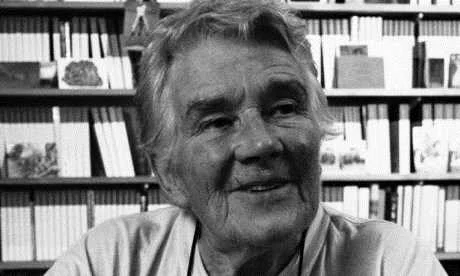
Dervla Murphy at 80: Living at full tilt
I vividly remember my first meeting with Dervla Murphy in 1979. Husband George and I had just arrived at a hostal in Otavalo, Ecuador, while researching our guide to Backpacking in Venezuela, Colombia and Ecuador. I emerged from our room to find George chatting to a tough-looking woman with an Irish accent. She was telling him where to buy good yoghurt . . .
Irish cycle tourer, author of 23 books and one of the great travellers of our age turns 80 today. Hilary Bradt celebrates a feisty and freewheeling life in Wanderlust Magazine
I vividly remember my first meeting with Dervla Murphy in 1979. Husband George and I had just arrived at a hostal in Otavalo, Ecuador, while researching our guide to Backpacking in Venezuela, Colombia and Ecuador. I emerged from our room to find George chatting to a tough-looking woman with an Irish accent. She was telling him where to buy good yoghurt. As she returned to one of the basic rooms that faced the central quadrangle, we held a hushed conversation.
“Do you think that’s Dervla Murphy?” George asked (we had heard that she was mule-trekking in Peru with her nine-year-old daughter, researching a book).
“Oh no,” I said, “she’s a proper writer; she wouldn’t stay in a place like this!”
But later that day George asked her anyway. Her face conveyed a mixture of surprise and dismay. “I’ll get some rum,” she said.
READ ARTICLE
Travelling a different path
If I am to be remembered, I’d like to be remembered as someone who was interested in the ordinary people of whatever country I was in . . .
Colette Sheridan interviews Dervla Murphy for the Irish Examiner
Before intrepid travel writer Dervla Murphy was born, her mother met a Romany woman in England who predicted that she would marry a small, slim, dark man and would live among trees and endure a long illness.
She was told she would only have one child, a daughter, who would be famous.
In her disarmingly frank autobiography, Wheels Within Wheels, published in 1979, Murphy writes that she never wanted to be famous but hoped that the fortune teller’s “blanket term covered authorship”.
And so it came to pass. Murphy’s mother, married to a librarian posted to picturesque leafy Lismore, Co Waterford, contracted rheumatoid arthritis when Murphy was two years old. She was looked after by her daughter who left school at 14 to become a sometimes reluctant carer for the next 16 years until her mother’s death.
Murphy, who celebrates her 80th birthday on November 28, has led an extraordinary life and is famous for having cycled all over the world and written 24 books about her adventures. But being in the public eye doesn’t sit easily with this reclusive woman . . .
READ ARTICLE
Around the world in 80 years
Dervla Murphy rarely gives interviews. She is one of our most senior and prolific travel writers – more than 20 books in a half-a-century career – but she is extremely publicity-shy, from an age before blog and spin were part of a writer’s toolkit. She’s not a J D Salinger – there’s the odd public sighting or visit to an Irish bar – but this was her first interview for many years . . .
Hugh Thomson discusses the art of travel writing with Dervla Murphy
Dervla Murphy rarely gives interviews. She is one of our most senior and prolific travel writers – more than 20 books in a half-a-century career – but she is extremely publicity-shy, from an age before blog and spin were part of a writer’s toolkit. She’s not a J D Salinger – there’s the odd public sighting or visit to an Irish bar – but this was her first interview for many years.
We were meeting at the Royal Geographical Society, a place where “a drink” usually means a sherry in the director’s office, and to fortify herself for the ordeal Dervla sent out for some Guinness and managed two pints before lunch. In the flesh, she’s cheery, engaging and with a determined gleam to her eye. She never looks back – or rereads any of her books once dispatched to her publishers, even now when many of the early ones are being reissued to mark her approaching 80th birthday. But any worries I had about her diffidence were quickly blown away. Once she gets talking, she has the boldness, as they say in Ireland, of the very shy . . .
READ ARTICLE
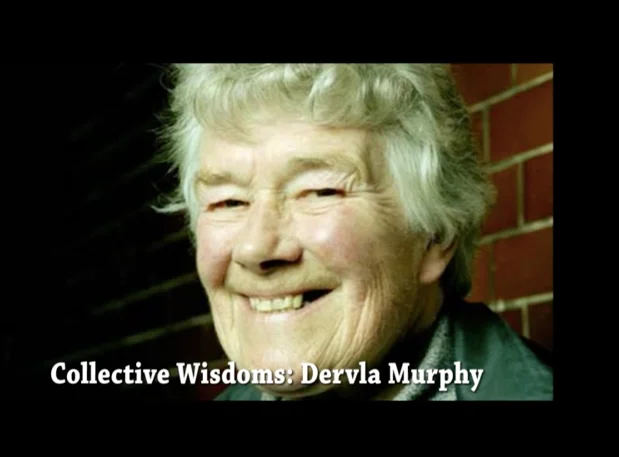
Around the world on a bike
'Murphy is adept at getting under the skin of a nation, rarely happier than when eating local food and drinking beer in the kitchens of the people she meets en route. She is honest and determined, but never sentimental about the sometimes desperate situations she experiences and the lives she touches.'
After a series of accidents foiled her first attempt, silver-haired adventurer and consummate travel writer Dervla Murphy returned to Russia to travel through the Siberian Urals on a bike. Clover Stroud of The AGE Magazine met a woman undaunted.
That Dervla Murphy packed a pistol on her first major journey cycling from Ireland to India provides some indication of how lengthy and colourful her career as a travel writer has been. Now 75, and with a lifetime of travel behind her, she made that first long trip when she was 32, cycling through Europe, Turkey, Iran, Afghanistan and over the Himalayas into Pakistan, writing letters home to four friends as she went, which provided the content for her first book, Full Tilt. ‘In those days getting hold of a gun was simple. I went to the local gardai, got a licence and went to a gun shop, where I bought a small .25’, she remembers. Luckily the pistol was only ever used against wild animals, but came in handy during the bitterly cold winter of 1962-63. ‘There were wolves on the streets in Belgrade that year, hunting together because it was so cold. But travelling with a pistol seemed very innocent then: it was in the days before terrorism took over the world, although later I did decide that it was probably safer to travel without one, so I sold it in Afghanistan.’
Such statements are characteristic of Murphy, one of the most prolific and best-loved travel writers of the last century, a woman The New York Times described as having ‘an indomitable will … and almost Monty Python-like stiff upper lip’. Certainly her most recent trip to Siberia by bike reveals all of her extraordinary determination and daring, while her first trip there, in the summer of 2002 when she was 70, was fraught with mishaps. She had hoped to combine a 2,300 mile journey on the Baikal-Amur Mainline train from Moscow into the Russian Far East with a 1,300 mile trip up the Lena river, as well as a huge amount of bicycling on a paddle steamer through the vast emptiness of Siberia before taking the train back to Moscow from Vladivostok. But during the early part of her journey through the Urals she damaged the cartilage in her knee when she slipped on the floor of a train. Nursing a wound that might have sent someone 40 years her junior straight back to Ireland, she was not discouraged, sufficient to get her back on her bike for her travels. Disaster struck again when she injured her ankle falling through some rotten planks in a latrine, further injuring her knee, and calling a halt to any sort of bike trip. Still, she finished the trip by train and paddle-boat, and published Through Siberia by Accident.
She later returned to Siberia to complete the original trip and the resulting new offering is Silverland, an account of this winter journey by bike beyond the Urals. Her writing is characterised by her idiosyncratic voice as she encounters adventures in the lives of the Siberian people. Murphy is adept at getting under the skin of a nation, rarely happier than when eating local food and drinking beer in the kitchens of the people she meets en route. She is honest and determined, but never sentimental about the sometimes desperate situations she experiences and the lives she touches.
The circumstances of these two trips to Siberia are also important as they illustrate Murphy’s extraordinary tenacity and resourcefulness as a traveller and writer. She was born and brought up in Lismore, by parents she describes as ‘Dublin bourgeoisie’. Her father was the librarian for Waterford library, and her parents encouraged her early ambition to travel. ‘I could take you to the exact spot on the road in Lismore where, when I was just ten years old, I first decided I wanted to cycle to India,’ she says.
In the deeply conventional Ireland of the 1930s and 1940s, Murphy was lucky to have parents who were essentially unperturbed by their daughter’s notions, as travel was not something that they had grown up with. ‘Travel writing seemed like a normal career to attempt, but I have no idea where that desire really came from, as my parents had never been outside Europe. My mother was the first to suggest going off on my bike when I was 18, and in those days there were not many mothers who would encourage that, especially in Ireland.’
But her career as a travel writer was stalled when, at 14, she was called home from the Ursuline Convent where she was educated, to nurse her invalid mother. She would carry on looking after her until her mother’s death when Murphy was 31. ‘It was rather difficult, but I was lucky to have a mother who encourage my desire to travel on a bike at all. I didn’t do any longer trips until I was into my thirties, but when I was looking after my mother I would go off for a month to bike around the continent in the summer. However, my mother was totally dependent on me, so I could never go away for very long.’
Funding her early trips by writing articles for local Irish journals, she also tried her hand at writing novels, but realised quite quickly that her real talent lay in travel writing. Certainly, her writing is characterised by an intense and authentic connection with normal people. She likes to get right into people’s sitting rooms, into their lives and really to understand what drives their emotional and intellectual lives – extraordinary considering that frequently she does not speak the language. In Siberia, unable to speak Russian, she relied on a small dictionary and a creative use of sign language to communicate with the people she met. The fact that she was a lone grandmother travelling by bicycle in a part of the world where foreign guests, let along those travelling by such an eccentric form of transport, are almost unheard of, meant that she attracted a great deal of interest from the local people.
‘For me, travelling on foot or by bike is really the only way to get to know a country and its people. And I like to be close to the elements. You are able to use all your senses in a way you cannot in a motor vehicle, which I really have no interest in, although I love train travel, especially in a slow train,’ she says laughing as she adds, ‘I went on the Eurostar once, and that was enough.’
After her mother’s death, Murphy struck out around the world on her own, and in her early thirties, travelled through and wrote about India, Tibet and Ethiopia. But in 1968, at the age of 37, she had a daughter, Rachel, by Terence de Vere White, then literary editor of The Irish Times. ‘Of course, it was fairly scandalous at the time, and although it was the 1960s and things were on the turn in England, they certainly were not in Ireland,’ she remembers. ‘And if I had been vulnerable to it there would have been a lot of disapproval expressed, I’m sure, but I really did not give a damn about what anyone else thought, so the tremors soon died away.’ She was also fortunate that she was then well-established as a travel writer and owned her own house, so was wholly capable of raising Rachel on her own.
Realising that a young child needs the stability of a home, Murphy temporarily stopped travelling and earned her living as a book reviewer, but when Rachel was five she packed her bags again, and with her young daughter in tow, went to Southern India, the first of many trips they would take together, including journeys through Peru, Mexico, Russia and Cameroon. Now married and with three daughters of her own, Rachel, who lives in Italy, has clearly inherited her mother’s wanderlust. Last year the two of them took Rachel’s young daughters to Cuba for a month, after which Murphy returned to complete a journey there along. ‘Rachel and I were talking about the trips we did together when we were camping in a forest with the girls in Cuba,’ says Murphy, ‘the world is changing at such an extraordinary rate now, and Rachel was very lucky indeed to experience the tail end of the proper old-fashioned travel, when you really did feel as if you were walking through undiscovered country. We trekked in the Andes together when they were practically empty, but it would be very different now because of mass tourism.’
As she has matured, Murphy’s writing has become increasingly political, and she broaches controversial tropics such as the effects of mass tourism on the world and the role of NATO or nuclear power, an approach which has attracted some criticism from those who feel that her role as a travel writer should be to record what she sees rather than judge it. Her writing moved away from straight travel writing in the early 1980s, when she followed her book on nuclear power, Race to the Finish?, with a book about Northern Ireland and race relations in Bradford and Birmingham, Tales from Two Cities.
Later she went to Rwanda two years after the mass genocide, publishing Visiting Rwanda, and was in Romania two weeks after Ceausescu fell, when she wrote Transylvania and Beyond, among the 20 titles that she has published over the course of her life. ‘But it’s getting harder and harder to find places to visit where you are not going to bump into flocks of teenagers, travelling in packs and collecting stamps in their passports.’ She admits to a desire to go to North Korea, and is scathing about her critics. ‘Of course my writing has changed; you do not go on writing in the same vein at 70 as you did at 35. Your interests and perspective change a great deal, because I really did not just want to go on telling the story of my journeys. I became more interested in the bigger picture about how people were functioning after a major event, which is where the inspiration for my writing in Rwanda, South Africa and Romania came from. There are a lot of things to be criticised in my writing, but being too politically involved is not one of them,’ she says firmly.
Living alone in Lismore, planning another daring foreign trip, Murphy is something of an anomaly in the 21st century. She rarely gives interviews, does not accept advances for her books, washes her clothes by hand and certainly does not subscribe to email. She is a master at travelling light, packing in her panniers the bare essentials of a sleeping bag, tent, sponge bag, maps and, of course, her notebook. She travels alone, and is not afraid of bedding down in a forest at night. She has rarely been afraid on her travels, but does admit to the idea that a land and a place can keep an imprint of the suffering that has gone on there before. In Siberia she felt something of the horrors of the Gulag lingering within the environment, despite the extraordinary hospitality and kindness that she received from the people there. ‘I am never afraid of travel but I have been a bit creeped by certain landscapes at times. When I was pregnant I was trekking along in eastern Turkey and camped in a huge valley that gave me terrible goose pimples. I didn’t feel at all comfortable there, even though I knew nothing about the history, but I later found out that it had been the scene of a major Armenian massacre.’
Despite the odd hairy moment, she remains, in her seventies, undaunted. Her only problem as a traveller is that there is very little left of the undiscovered world she has not already discovered. ‘I don’t think that my sort of career is possible for the coming generation,’ she says. ‘Real travel is so difficult to do now. So many countries have been ruined by mass tourism or war. Terrorism too has changed the way that you can travel. But I think that to a certain extent, we have become hysterical about our own safety. Perhaps big cities are more dangerous than they used to be, but once you get out into the wide open spaces, I think that you are as safe as you have ever been.’ And it is in those wide spaces, the wind behind her and her panniers strapped onto her bike heading off into the unknown for another adventure, that Murphy feels most at home. Long may she cycle.
The AGE Magazine, November 2006
The light of Lismore
At 10 years old, Dervla Muphy planned her first major odyssey: a cycling trip to India. Now 78, the seasoned travel writer still drinks beer from a tin, has been known to run naked around her garden, and hasn’t given up travelling – even when she’s at home in Waterford . . .
Rosita Boland interviews Dervla for The Irish Times
At 10 years old, Dervla Muphy planned her first major odyssey: a cycling trip to India. Now 78, the seasoned travel writer still drinks beer from a tin, has been known to run naked around her garden, and hasn’t given up travelling – even when she’s at home in Waterford.
The first thing travel writer Dervla Murphy does when I call about arranging a time for an interview at her home in Lismore, Co Waterford, is to offer me a bed for the night. Interviewees do not, as a matter of course, offer journalists accommodation. But when you have traversed the world, as Murphy has, receiving indiscriminate hospitality from strangers for almost half a century, it seems entirely appropriate that her instinct is to offer likewise for someone passing by in transit . . .
READ ARTICLE
A birthday tribute
Many people have stayed with Dervla, or been host to her, during the 48 years that she’s been a writer, and any who visited her during the winter will remember the challenge of keeping warm (“I wonder if it would be possible to have a bath?” I asked on my first visit. “The river’s down there” she responded. It was while bathing in the same river some years later that a frisky bull charged her and broke some ribs – or possibly her back, I can’t now remember) . . .
Dervla Murphy - a birthday tribute by Hilary Bradt
My interview with Dervla, who will be 80 on November 28 2011, will be published by Wanderlust in the next couple of months, but I could have written twice as much about this delightful and wonderfully eccentric travel writer, so I’m jotting down a few additional quotes and memories here, while they’re fresh in my mind.
Many people have stayed with Dervla, or been host to her, during the 48 years that she’s been a writer, and any who visited her during the winter will remember the challenge of keeping warm (“I wonder if it would be possible to have a bath?” I asked on my first visit. “The river’s down there” she responded. It was while bathing in the same river some years later that a frisky bull charged her and broke some ribs – or possibly her back, I can’t now remember). Her hosts remember the challenge of keeping up with her questions: “When we emerged blearily for our morning coffee, Dervla was already, after having listened to BBC since 5am or so, fired up and full of questions we barely felt we could answer. We’re not economists or politicians but Dervla’s questions demanded that kind of substantial response.” (Wendy Woodward, Cape Town.) And we all remember the 5am starts. I recall carefully unfolding myself from the foetal position that I had held all night to conserve heat to see Dervla, bare-armed, carrying child-sized boulders across the patio to build a rockery . . .