
Your Custom Text Here
Dervla Murphy on Naples '44
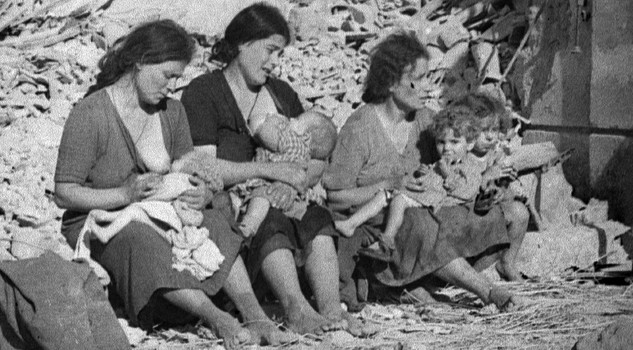
ARMY OF OCCUPATION by Dervla Murphy
Originally published by The Irish Times, 1983.
ON OCTOBER 20th, 1944, Norman Lewis wrote in his journal, “A year among the Italians has converted me to such an admiration for their humanity and culture that were I given the chance to be born again, Italy would be the country of my choice.” This explains why “Naples 44” gives an overall impression of beauty, dignity, mellowness, graciousness; the hallmarks of indestructible traditions serenely surviving the barbarisms of yet another war. In his journal Norman Lewis recorded every sort of brutality, corruption, chicanery, depravity and squalor. Yet he never allowed himself to be depressed by his experiences as a field security officer.
Always he remained aware of immemorial controlling rituals below the surface, of wit glinting through the most macabre and sordid “deals”, of exotic codes of honour and courage giving a bizarre—and not entirely phone—aura of respectability to the most outrageous Mafia manoeuvrings. Always, too, he responded to people as individuals; so his pages vibrate with the entries and exits of a preposterous yet wholly credible cast of happy rascals, melancholy eccentrics, lascivious noblewomen, licentious soldiery, keen-witted child-crooks and suave Black Marketeers who might be anything from senior officers of the Allied Military Government to Vatican prelates to Community Party bosses.
Of course for an ordinary decent Englishman it was all a bit confusing at times, especially as Field Security personnel were allowed an astonishing autonomy which could put them in uncommonly awkward situations. They were expected to combat corruption only in so far as it affected the operations of the Allied Armies. But often it was hard to know where to draw the line; or, indeed, whether it was would be prudent to draw any line. Towards the end of his year in the Naples area, Norman Lewis wrote sadly: I personally have been rigid when I should have been flexible. Here the police—corupt and tyrannical as they are—and the civil population play a game together, but the rules are complex and I do not understand them, and through lack of this understanding I lose respect.”
“Naples ‘44” forces us to dwell on the physical and moral dreadfulness of what is now quaintly called “convention war”, to distinguish it from that sophisticated nuclear war—all new and different and excitingly unconventional—at present being considered as a “possible option” by the Pentagon.
On September 11th, 1943, at Salerno, Norman Lewis learned that Americans of the 45th Division had been ordered to take no German prisoners and to beat to death with their rifle butts any German who tried to surrender. Mr Lewis wrote that evening: I find this almost incredible.” A fortnight later he was relieved to noticed that some of the Americans were “beginning to question the ethics of this order. One man who surrendered to a German tank crew was simply stripped of his weapons and turned loose because he could not be carried in the tank, and as a result he is naturally a propagandist for what he accepts as the general high standard of German humanity.”
As German tanks rolled towards the Allied position at Salerno, the American officers stealthily deserted, abandoning their men, who soon succumbed to total panic and “in the belief that our position had been infiltrated by German infantry began to shoot each other and there were blood-chilling screams from men hit by their own bullets … Official history will in due time set to work to dress-up this part of the action at Salerno with what dignity it can. What we saw was ineptitude and cowardice spreading down from the command, and this resulted in chaos.”
Norman Lewis also records his compatriots’ misdeeds. At Secuirty Headquarters in Salno, he saw a British officer interrogating an Italian civilian by battering his head with a chair—“a treatment which the Italian, his face a mask of blood, suffered with stoicism.” The officer then called in a private of the Hampshires and asked him, “Would you like to take this man away, and shoot him?” The private spat on his hands and replied, “I don’t mind if I do, sir.” Norman Lewis described this as “the most revolting espied I have ever seen since joining the forces.” But of course there was much worse to come.
When the French colonial troops took a town or village, they raped the entire population—old men and children as well as women of all ages. Often two Moroccans assaulted a woman simultaneously, one committing sodomy while the other had normal intercourse. Many victims suffered damage to the genitals, uterus and rectum. At Ceccano, the British had to build a guarded camp to protect the Italian from the Moors—many of whom had by then joined other deserters, from all the Allied Armies, in terrorising areas far behind the line of battle.
Norman Lewis wondered, “What is it that turns an ordinary decent Moroccan peasant into the most terrible of sexual psychopaths as soon as he becomes a soldier?” A few days later he was recording Italian vengeance: Five Moors were given food or wine containing some paralysing poison. While fully conscious they were castrated, and then beheaded. The decapitation was entrusted to pubescent boys to prove their worth, but the boys lacked both the skill and strength to carry the task out in a speedy manner.”
* * * * *
“Naples 44” frequently reminds us that modern man is the most dangerous of all animals. We who lead sheltered lives can at times delude ourselves that civilisation is winning out, that we of the 20th century are not as our forefathers were—delighting in public hangings, and all that. But once war has removed the restraints imposed by modern society, most men still behave like the hordes of Attila the Hun, whether they be Guards officers or Moroccan peasants. Where we really have advanced is in the devising of national international structures for the maintenance of laws and order. And perhaps one day, if we survive long enough, we’ll learn how to use those structures effectively, to avoid war.

Norman Lewis: A Curious Collector of Curiosities
Can a book save one’s life? I used to think so when stationed in Mogadishu, avoiding thoughts of murder or suicide in that sunburnt madness only by immersing myself in Gerald Hanley’s Warriors (1971). Day after day I would throw myself on to my bed after another utterly fruitless, pointless day in the president’s office, and lie down, sweating beneath squadrons of flies and mosquitoes, and try to forget about it all.
By Pico Iyer
Pico Iyer is a British-born essayist and novelist of Indian origin, best known for his travel writing and in particular his books Video Night in Kathmandu, The Lady and the Monk and The Global Soul. He has written for Time since 1986 and his essays and reviews have appeared regularly in Harper's, The New York Review of Books and The New York Times.
The following essay appears in the book Tropical Classical: Essays from Several Directions.
Norman Lewis is a dangerously easy man to idolize, if only because he lives so far from self-idolatry. A writer’s writer and a traveler’s traveller, in the very strongest senses of those words, he has quietly gone about his business for fifty years now, writing thirteen novels and, more famously, perhaps, ten works of nonfiction that mix beauty and irony in the most elegant of watercolours. Everywhere you go, in time and space, you seem to find Lewis: eon Indochina, in the early ‘50s, negotiating over chrome-plated American cars in a Phnom Penh opium den, then meeting the Vietminh guerrillas through a taxi girl; in Cuba, at the outbreak of the revolution, amiably chatting with Fidel’s executioner, an American who sports cuff links made of spent shells; in Togoland, being served on the veranda by “white-coated, whispering stewards who moved as stealthily as Indian stranglers”; in Naples, as a British intelligence officer, presiding over a scene of almost Dantean horrors, in which corpses of grown men were squeezed into child-size coffins and princes begged their sisters to become whores. His sunlit elegies of Vietnam and Burma (A Dragon Apparent and Golden Earth) were best-sellers in the ‘50s, and his novel The Volcanoes Above Us sold six million copies in the Soviet Union. His eerily knowing account of the Mafia (The Honoured Society) was serialized in six enormous parts in The New Yorker, and his report on the genocide of Indians in Brazil was at the time the longest article ever published in the Sunday Times of London. Lewis wrote about the destruction of the Amazon rain forest ten years before it became a fashionable issue, and his investigations into the elimination of indigenous peoples led to the creation of Survival International. Yet through it all, he has consistently written his seven hundred words a day ins a state of “almost monastic calm” in the English countryside, far from the glamour of London’s literary circles, far from the headlines. Norman Lewis is one of the world’s last unguarded secrets.
Among his peers, Lewis has become a kind of surreptitious hero, and the connoisseurs of modern British writing have vied with one another in their eagerness to laurel him in praise. Cyril Connolly wrote that “Mr. Lewis can make even a lorry interesting,” and V. S. Pritchett that “he really goes in deep, like a sharp, polished knife.” Auberon Waugh, son of Evelyn, has called him “perhaps the best [travel writer] since Marco Polo,” and the British papers routinely describe him as “the doyen of our travel writers.” In recent years, moreover, his reputation had enjoyed a kind of Indian summer, as his early travel books have been reprinted, while his newest pieces have been showcased in magazines like Granta. Yet perhaps the greatest compliment of all for this mild-mannered, self-effacing man with the scholarly air, now eighty, comes from the almost legendary British photographer Don McCullin, who has made a career of venturing where mortals fear to tread. “There was one writer who always brought out the best in me,” writes McCullin in his recent autobiography, Unreasonable Behaviour, “and in a way I became his disciple.” The role model for the swashbuckling was correspondent turns out to be none other than the rigorously unshowy, self-denying Lewis, “the kind of man,” as McCullin writes, “you could pass in the street without realizing anybody had gone by.” In a tone of near reverence, McCullin describes Lewis, already in his seventies, wading waist deept through Venezuelan rivers, serenely hopping up and down while a tropical fish makes mince-meat of his groin; Lewis imperturbably sitting in a red-light hotel while peasants make rowdy preparations for a cockfight; Lewis visiting a local witch doctor—named Mary Skull—whom even McCullin cannot face.
So when I went to visit the retiring writer, on a drizzly winter afternoon, in his remote village in Essex (“the ugliest county” in England, as he gleefully calls it), I did not know quite what to expect: Lewis so shies away from the spotlight that the library records only two interviews with him over the past three decades, and his entry in Who’s Who is as short as possible. I was somewhat taken aback, therefore, when a highly courteous man with a wistful smile, in thick sweater and sturdy corduroys, came out into the rain to greet me. As he led me into his four-hundred-year-old Tudor parsonage and graciously sat me down in a room full of African prints, Siamese angels, and Islamic miniatures, I felt myself in the presence of a kind of watchful, kindly owl, with a courtly military bearing. And when I brought out my tape recorder, Lewis peered at it with the same beady-eyed, amused attention that he clearly brings to all his subjects, wondering aloud whether this intriguing machine might save him from the hazards or scribbling down all his notes in the back of an aged car jouncing along unpaved roads, in a hand so unreliable that he cannot read his notes himself by the end of the day. Such delightful discomforts he had enjoyed most recently in India, where, typically, he sought out only the most blighted, unvisited, and undeveloped areas, and came back with a vision of pastoral idyll. India is “so glamorous,” he said, “so civilized,” choosing perhaps the last two adjectives that most travellers would use. The very next week, soon after his eightieth birthday, and just back from Barcelona, he was off, alone, to the wilds of primitive Irian Jaya, buoyed beyond measure by having read that the local tribesmen has greeted some of the most recent Western visitors—missionaries—by “grabbing them all and executing them and barbecuing them! Thirteen of them! I’ve certainly got to get to this place!” he said with unfeigned enthusiasm. “Apparently, you’ve got to hire a helicopter at great cost, but I’ve got to go to this place and try to talk to someone who was involved in that great tribal meal!”
While awaiting his audience with the missionary-eaters, Lewis was tapping his fingers in an England that, in his idiosyncratic eyes, seems as alien as the Gobi. “Although I’ve spent most of my life in England,” he confessed to me in his soft, rough voice, “I’m temperamentally totally, totally Welsh. I really find very little point of contact with the English temperament. The people I know here actually hunt!” He made them sound far stranger than cannibals. “People living in Wales are almost as different as the Chinese,” he continued sotto voce. “They adopt a certain amount of natural color and polish, and often the right kind of accents, and appear like pukka English people”—his voice dropped to a conspiratorial whisper—“but they’re really quite different.” He made himself sound like a spy almost, an interloper investigating the strange ways of this tribe known as the English. “I’m probably trying to romanticize it, by the way,” he offered cheerily, just as I was falling into the spell, but the Welsh did, he believed, tend to be more nomadic, more evangelical, more ready to cry in public. “I am absolutely an outsider,” he concluded with quiet extravagance. “You could safely say that, apart from one or two people who come up from London, I’ve got no friends!”
Before long, in fact, everything in the house was beginning to take on the peculiar coloring of the Lewis world, and everything seemed fodder for his friendly self-deprecation. His very Engish-seeming wife came in with tea and scones. “Australian,” he confessed as she went out, all but throwing up his hands in helplessness. “My first wife came from a Sicilian family! I don’t feel I’ve organized or engineered this. It just happened.” Then his twenty-year-old daughter appeared. “Samara,” he explained, “which, as you know, in Arabic means ‘dark’. But she is completely blond!” Then he effected an introduction to his retriever, Sheba. He paused for a moment, then added gloomily, “All the dogs in this area are called Sheba”
Lewis’s whole life, indeed, as he tells it in his uncommonly strange and riotous autobiography, Jackdaw Cake, is one long brocade of fanciful absurdities. His father was a madcap pharmacist who would, claims Lewis, translate the prescriptions of his customers out of Latin, assure them that the prescribed goods were close to poison, and press on them instead a concoction of his own devising; his mother was greatly concerned with the children of Osiris. For part of his childhood, Lewis was sent to be raised by “three insane aunts” in a sullen, close, and incest-haunted Welsh village whose inbred little world of taboos and tribal curses he makes sound as alien as anything in Belize. One aunt was an epileptic, given to running screaming through the house once a day, and one cousin was a retarded boy who would walk with Lewis down shopping street, hitting matchboxes with a golf club. The main highlight of his hometown, he writes, was “a rubbish dump smouldering incessantly like a pigmy Etna.”
When he returned home, to the dreary London suburb that features (coincidentally) in the movie Life Is Sweet, it was, he writes, to find that his father had become a proleptic Buddha of Suburbia and now spent much of his time hypnotizing birds, wondering whether jellyfish had souls, and entertaining such professional contracts as “the shaman of the Blackfoot Tribe named Thunder Star, who in a fit of intense mental concentration had caused a small tributary of the Missouri River to run backward.” Graduating during the Depression, Lewis saw his friends move on to become an assistant rat-catcher, a crucifix salesman, and a professional punter at the Tottenham Palais de Dance. He himself went into business bottling his father’s elixir, taking pictures of weddings, and becoming what Time later called “a minor tycoon in photographic supplies.” By day he raced motorbikes; by night he entered literary competitions in magazines such as Titbits. (“I can safely say that I never won a first prize,” he assures me. “I probably won about two or three second prizes—over a long period—and innumerable third and consolation prizes.” He could almost be talking of his life.) He also got into the business of buying and selling cars, the first vehicle he owned being a boat-shaped Bugatti whose dashboard was covered with “a pair of lovers in lascivious oriental inter-twinings” and whose radiator cap was a representation of the elephant god Ganesha (the addition of its former owner, and Indian). Like all the details in his life, it sounds almost too good to be true.
By his mid-thirties, his circumstances were already irremediable tragi-comedy. He married, almost without meaning to, a wild and mercurial Sicilian girl, whose father was a minor Mafioso. When he took the Sicilians to meet his parents for the first time, he writes, everything was going swimmingly until his father suddenly started receiving messages from the Other World and began writhing and babbling uncontrollably. He took a message for his father-in-law to a bowler-hatted Italian count (married to a former Miss Italy) who promptly suggested wife swapping, and then he signed on as a photographer to go to North Yemen with Ladislas Farago (“an extremely charming villain,” he remembers, who later became an advisor to Nixon and, after fabricating a story about meeting Marti Bormann in South America, a millionaire). One day, not long after being stuck in the middle of a hurricane in Cuba and hearing about how voodoo dolls could be purchased at the local Woolworth’s, Lewis learned that war had broken out in Europe. Hurrying back to Britain to elist, he was dispatched to Algeria (because he spoke “Adenese bazaar Arabic”—as well, though he rarely mentions it, as Russian, Spanish, French, German, Italian, and even Welsh). His commanding officers in intelligence were—in this rare telling—an expert in Old Norse, an Australian obsessed with coal, and a man who chose to address subordinates while shaving off his pubic hair. His field security officer spent most of his time talking Latin. At war’s end, he writes, his doctors told him he “should make no attempt to come to terms with a regulated and sedentary existence.” Thus he embarked on the two most unstable of all occupations, traveling and writing.
Lewis assures me now that he had no training in writing. On the steamer to North Yemen, he found books by Somerset Maugham and Ernest Hemingway, and the latte quickly became his hero. (Many years later, he was sent by Ian Fleming to Havana to look in on Hemingway, arrived to find that his contact there, the man who was partially the model for James Bond, had just challenged Papa to a duel, and, when finally he saw the Nobel Prize-winning author, found him so sad that “it was hard to believe that he would ever smile again.”) Not rich enough to buy books, he found his only other source of learning in the local library, which, through an eccentric bequest, had none of the English books Lewis wanted to read but an enormous collection of Russian novels, “shelf after shelf, with every Russian novelist, including all the obscure ones.” So the young Lewis devoured them all. “I was dazzled by Chekhov, for example, and by comparison with the kind of stories that were being published in English magazines, they were extremely realistic. Even the people in Samarkand or Central Asia, in Chekhov, in highly exotic situations, struck me as eminently believable.” And even now, he so loves good prose that he underlines fine sentences in the newspaper.
It is tempting, when first one enters Lewis’s books, to see him as one of the last examples of that endangered species, the intrepid English traveler—he was, after all, a near contemporary of Robert Byron, Evelyn Waugh, Peter Fleming, and Wilfred Thesiger. Yet in reality, nothing could be further from the truth. Not just because Lewis feels so estranged from England, but more because he has always lived a universe away from the clubby small world of his traveling compatriots. Where more of them were Eton and Oxford boys who travelled the world with the imperial confidence of empire builders on vacation, and roamed around Ethiopia and Afghanistan safe in the knowledge that there would always be some school friend waiting for them at the next consulate with a gin and tonic, Lewis always traveled alone, grew up humbly, never went to university, and financed all his travels with his own implausible business. And where they customarily made their exotic destinations a setting for a knockabout comedy or sportive digression, speeding through them in a mood of blithe urbanity, Lewis made foreign cultures his one and only subject. Settling down abroad, disappearing into the background, and unobtrusively living like a local—travelling to Burma in a longhi skirt, eating food with his hands in India, going on dog-buying expeditions in Vietnam—he acts as if he were one of the natives’ most eloquent spokesmen. He seeks not to rule the world but to give himself over to it. And in place of breezy, chatty entertainments, he produced books of lush and highly detailed beauty—textured, contextual, meticulous—in which amusement and affection play upon their subjects like sunlight off a stream.
Indeed, not the least striking thing about his romantic adventures is how little he seems to dwell on them. Lewis’s books and travels are stuffed with almost impossibly colorful and curious happenings, yet none of them disturbs the stately and majestic flow of his rich and study paragraphs. In his autobiography, he devotes exactly one and a half pages to the last thirty-five years of his life, and one paragraph to his divorce; burnished and polished until it shines, his prose simply rolls on, sonorous and imperturbable, through every event and emotion: in all the twelve books of his that I have read, I have never found a cheap or careless sentence (it is almost too fitting, in fact, that in the card catalogue, he is easily confused with another Norman Lewis, born just one year later, who wrote a book called Power with Words). There is something deeply settled about Lewis’s persona and his level prose that underwrites all his wandering, and something old-fashioned about his ability (like Colin Thubron) to fashion the most dignified of sentences while traveling third class. Out of marvels he makes melodies.
If you read the books very carefully, you will notice that Lewis contracted malaria three times, fractured his skull in a car crash, and saw his skin and the whites of his eyes turn yellow. He saw men brain one another with the femurs of corpses and the howling procession of a bush devil. Yet none of this detains him for more than a sentence or causes his prose to lose its breath or poise. It is this almost implausible sense of reticence, together with his brush mustache and his air of gracious decency, that gives Lewis something of the sepia glamour of the strong, silent type in an old British war movie, tall, observant, good in an emergency, and full of sympathetic fortitude (one of the great ironies of his life is that this most implacable of Empire-haters embodies the very qualities of open-mindedness and honesty that made the Empire work: he is the kind of upstanding, understanding type who seems to belong to a Paul Scott novel). The most impressive thing about his knowledge of obscure places is how little he seems impressed by his own place in them: even the British reviewers, so suspicious of self-display, have sometimes complained that he is almost too modest. “I may be selfish,” he told me matter-of-factly, “but I don’t think I’ve got a normal, average ego.”
It is this kind of stiff-upper-lip sangfroid that distinguishes Lewis’s first two Asia books, which are still, in many ways, the best introduction to his work. Traveling to Vietnam and Burma in the early ‘50s, when both were still isolated and undiscovered (much as he is), he came back with what is still, forty years on, the definitive portrait of Indochina in all its sleepy, riverine languor, and Burma’s unworldly charm (he completed a trilogy with his tour around a timeless India). Lewis has always seemed to have a soft spot for lazy, shady, spellbound lands—he still schedules his trips so as to escape the gloom of the English winter—and he seems to warm up to cultures that enjoy a kind of easygoing tropical morality, far from the puritanism and “joyless prosperity” of the north. Somehow, one always sees him in the sun, in some quiet rural setting, surrounded by people in festival mood (both the Laotians and certain Indians, he claims, regard it as ill bred to work). And everywhere he goes, he follows no agenda but the satisfaction of curiosity. When I asked him, for example, if he’d ever write on South Africa, he looked astonished. “To write well about a thing, I’ve got to like it. I’m not going to be infuriated all the time.”
Those first books, moreover, lay out all the distinctive features of his universe: the stoicism, the delight in beautiful absurdity, the sense of sunlit requiem. Though he scarcely mentions it (three separate Indochinese rebellions “made traveling conditions sometimes arduous,” he writes negligently), Lewis slept in rooms full of scorpions and rats, crouched like a hermit crab in a hole in the back of a bus, aware that if bandits attacked, he would be the first to be killed, and ventured blithely into war zones, encouraged in one instance by the advice of a man named Oh Oh, who assured him that he was in no danger of an ambush (but was very likely to get attacked). Over the course of his travels, I have noticed, Lewis has drunk black frog spawn, munched qat leaves, and eaten Belizean rodents, locusts en brochette, camel-hump fat, and lamb’s testicles. In India, as a septuagenarian, he happily went to all the murderous areas that even Indians shun.
Lewis, in fact, is one of those even-tempered travelers who seem almost to relish things going wrong—in fact that the pilot scarcely knows what he’s doing, or the maid barges in a dead of night, “bearing a raw potato on a silver tray.” He is the most equitable of travelers, partly because he is the least provincial of souls (he actually apologized to me for having had to spend one night in a deluxe hotel in Calcutta). And so complete and omnivorous is his absorption in the world around him that he manages understatedly, to assemble a mosaic of unlikely details. In Burma, a monk carrying around a “biscuit tin commemorating the coronation of King Edward VII, on which had been screwed a plaque with the inscription in English: ‘God is Life, Light and Infinite Magnet’”; in Vietnam, a group of village children being taught to breathe, some local beauties putting on a version of Oklahoma!, and thirty-seven schoolchildren singing, under a ritually polished buffalo skull, “Auld Land Syne,” in French. The world he finds is at once utterly plausible and utterly strange, perfect material for his hilarious, deadpan wit. In Vietnam, for example, he is especially fascinated by the Cao Dai religion, which worships Buddha, Jesus, the Jade Emperor, Victor Hugo, and La Rochefoucauld, among others. At dinner one night, he finds himself next to a devotee who asks after Victor Hugo. “ ‘I am a reincarnation of a member of the poet’s family,’ the young man said. I congratulated him and asked if he also wrote.” It is not hard, with his mix of dry humour and propriety, to see why his best friend (when he admits to one) was S. J. Perelman.
Yet however much he revels in the oddity of things, in the end Lewis catches most of all a sense of rural quiet, and of Eden. “A distant clock chimed sweetly an incorrect hour.” “Sometimes as the car passed a scarlet thicket of cactus and geraniums, a nightingale scattered a few notes through the window.” “All day and all through the night the cool sound of gongs comes over the water from unseen Moi villages.” His sentences take flight on lyric wings. Luang Prabang was “a tiny Manhattan—but a Manhattan with holy men in yellow in its avenues, with pariah dogs, and garlanded pedicabs carrying somnolent Frenchmen nowhere, and doves in its sky.” “Down in the village,” he writes of Ibiza, “life moved on with the placid rhythm of a digestive process,” and his prose has this same almost vegetative calm, soaking up the cadences of the unhurried villages that to him have all the timeless rhythms of a paradise.
Yet all paradises are made to be lost, and if most of Lewis’s travel books are love songs, they are also elegies, memorials to a purity threatened or already gone. All his books have this sense of dusk in them, of coming darkness; he went to Indochina and Burma, he wrote at the time, because he feared that their fragile cultures would soon be lost of else closed off to the world (and in both suspicions he was right). Cultures are often protected, he believes, by insurgency, pestilence, and bad government, and “progress” often marks the beginning of the end for them. Perhaps the strongest expression in all his books comes in the preface to a reissued collection of journalism, in which he sorrowfully, and unequivocally, repudiates his earlier belief that any place could ever remain unspoiled.
So intense is this sense of loss that he finds the same pattern even in England. He bought his present house thirty-three years ago, he tells me, in part because he saw a green woodpecker in the garden, “the only exotic bird in England,” and in it he saw a way to cultivate his fondness for “plants and all growing things.” To this day, he brings back samples from his travels and plants them into his garden, a third of which he has turned into overgrowth to “encourage the presence of the occasional fox, rabbits, birds.” At its best, he finds himself still living in a kind of rustic paradise. “I like to walk around the countryside,” he tells me. “If there are any birds or flowers, I make a note of them, and look at the scenery; think; and go home.” And even in England he finds traces of the protected, medieval village that attracts him everywhere. “Even now there are people here whose surnames I don’t know—incredible!” No one haggles, or worries about race, he says; “the people we deal with here are an extremely kind people,” and best of all, most things in the village “are more of less as they were seven hundred years ago.”
Yet here, too, he has seen the unfallen vision fade. When he arrived, he says, “wherever you went for a walk, there used to be hares gamboling around hedges. Now everything’s gone. No flowers: they’ve all been sprayed out of existence.” Worse still, the ancient rhythms of the place have been disrupted by “people from the city, with their different morality, and different standards, and the commercialism that goes with supermarkets. With every decade that goes past, the villages is 25 percent uglier than the decade before.” The area’s new medical building, he says, “looks like a paramount chief’s kraal in Zambesi. It’s totally exotic, and it’s the wrong kind of exoticism. Its unsuitability is extreme.” Then, just as he’s getting most passionate, he gives me his godfatherly twinkle. “Mind you,” he says, “that’s a typically exaggerated response.”
Thus Lewis’s primary role, in a sense, is that of a caretaker or protector of endangered cultures, practices, and peoples; more and more, this former photographer and camera salesman seems to be traveling to places to rescue them, or at least to bring back snapshots of a vanished world. While some travel writers ornament and structure their impressions around history (as Jan Morris, say), and others literature (Paul Theroux), or even personal and natural history (Bruce Chatwin), Lewis is closest to an anthropologist, a student of the human animal who loves its most pagan and atavistic forms (“backward” is for him a term of the highest praise). Medicine men and superstitions are his thing, animist rites and secret societies (from Liberia to the Mafia). And where a writer like Morris, say, or even Theroux, is most at home in cities, catching the beat of dinner parties, buildings, and bright stimulations, Lewis is very much a pastoralist, drawn to the age-old rhythms of the village. (Part of the freshness of his Indian book comes from the fact that he never even visits Delhi, Varanasi, or Bombay, and never bothers, therefore, with the standard meditation on Indian energy and poverty; the India Lewis sees is not overcrowded but lonely, and the books he cites, living in his own untrendy world, are not those of Naipaul, Rushdie, or Chaudhuri, but authors like Ibn Battuta, in the fourteenth century, and seventeenth century like Portuguese travelers.) Like the best anthropologists, moreover, Lewis takes great pains to travel light, deferring to village customs (he always, one notices, uses local honorifics) and leaving his sense of right and wrong at home: in Naples, for example, he realizes that to refuse a bribe is to throw the system into chaos, and in India, to his delight, he finds tribal peoples for whom the ultimate sin is sexual fidelity. His gifts are not analytical; they are, rather, appreciative, those of an extremely patient, careful, tolerant observer who simply records details without passing judgment on them.
Indeed, if there is one flaw in all his writing, it is, I think, that he sympathizes so deeply and fully with aboriginal peoples, and is so put out by the threat of an air-conditioned future, that he comes close to creating an almost Manichaean struggle between “the gentle backward civilizations” and “shy primitive people” on the one hand, and the “juggernaut” of the modern world, on the other. The only people he seems not to savor are his own people, and, at times, one almost feels that he agrees with the Burmese (who regard foreigners as not quite human), or the Guatemalans (who think of tourists as nothing more than “ghosts”). At times, indeed, he appears so painfully aware of the dangers of “civilization” and so opposed to all forms of colonialism (not least the kind practiced by tourists) that the “poor, but supremely happy” natives seem almost too charmed to be true. When he writes, say, that Vietnamese armies used to carry lanterns at night to give their enemies a fighting chance to see them, or that cyclo drivers in Cambodia used to tip their passengers, one begins to suspect that his kindly eye can somehow see kindness everywhere, and that the other man’s garden is always greener. Sometimes, in fact, slapping off “the bourgeoisie” like so many flies, roughing it at any cost, and finding ways to live in Ibiza for a few pesetas a summer, this most gentlemanly of Old World scholars sounds like a classic hippie.
The paradigm of this process is captured in his book Voices of the Old Sea, an account of three summers he spent forty years ago as a fisherman in a tiny Spanish village. The book is, in effect, a wrenchingly detailed autopsy on the ruins of a place he loved. It is the tale of a decent and good-natured man who tries to build up the unspoiled village into a tourist site, importing foreign guitars to a place that has never known their music, turning restaurants into Moorish cafés, and bringing in dancing bears—turning the village into a version of the Spain that foreigners expect. Soon the primitive, Chaucerian world that Lewis first entered (where there was a taboo against wearing leather, and the fishermen, he says, spoke in blank verse, and village enchanters could be found) becomes a replica of itself, the locals are learning about bikinis and public kisses from wealthy French holidaymakers, and fishermen are turned into bellboys, exiles in their own home. I happen to be one of those who believe that the horrors of tourism are all too easily exaggerated and that, in fact, the trade often brings benefits as well as sorrows, quickening an interest in customs that may have long lain dormant, and providing people with a sense of choice, and opportunity, as well as the facilities that we, in our comfort, would often wish to deny them. Nonetheless, it is almost impossible to resist the heartrending cadences of Lewis’s lament, and his sadness as his second summer ends and he knows that the third can never be the same again. “The sun had crisped away the last of the stubble from Don Alberto’s land . . . and the dry clicking of a water-wheel turned by a donkey sounded like the solemn tick-tock of a grandfather clock deep in the ears.”
Not surprisingly, Lewis is the first to disparage this tendency in his own writing—“Every this Welshman would like the opportunity to get up in the pulpit, and I may be affected by that to some extent”—and frankly volunteers that he went through the whole of his manuscript on India, “cutting out numerous passages in which I thought I was taking a moral stance.” Yet the fact remains that in recent years his traveling has assumed more of a crusading aspect, and as well as being an observer, he is more and more a kind of witness. As he grows older, his lovely, careless rambles have acquired a greater sense of moral urgency, and his sympathy for embattled peoples has turned into a quiet indignation on their behalf. The focus of this outrage has been very much like the missionaries (the people most likely to affront someone who dislikes self-righteousness in any form and takes specil care not to impose on another culture’s values). Lewis has always been a glinting-eyed opponent to religion (the result, perhaps, of being the one skeptic in a household of fundamentalists); and he can hardly conceal his delight when the cry of the muezzin in Tunisia, due to a technical malfunction, intones only, “There is no God,” or when “God is Love” becomes, in tribal translation, “The Great Spirit is not angry.” The fishermen of Ibiza, he notes admiringly, were “almost savagely anti-Catholic” and regarded it as an ill omen even to set eyes on a priest; and one of the things that seem to have won him over to his first wife was that she despised religion. Lewis has always regarded missionaries as mercenaries of a kind, pledged to a conversion that is in effect corrosion, and so to a kind of ethnocide. And in his most impassioned works, he has conducted painstaking research to show how the very group set up to protect the Indians in Brazil went about exploiting—and even exterminating—them, while various American religious groups in South America have gone about conquering souls with the help of shirts infected with the smallpox virus and poisoned candies. Still, when I asked him about his literary influences, the one he singled out was the King James Bible. “I am probably one of the few non-Christians who has read the Bible through, amost of it two or three times,” he said, beaming. “Because it is superbly written, and the stories it contains are excellent.”
In a sense, indeed, Lewis has so strong an attraction to the extraordinary, and is so drawn to life in extremis, that his writing often acquires an almost theological intensity, as if some of the places he knew were suspending in a state of Arcadian purity, while others were lost in a fury of hellish confusion. If part of his vision seems drawn from Poussin, part of it seems derived from Bosch. And as one goes through his writing, one finds horrifying accounts of cruelty and terror almost beyond imagining: teenagers performing decapitations, men biting one another’s throats out, or (a typical Lewis irony) men who have eaten human flesh refusing liver on religious grounds. The epicenter of this can be found in his coruscating book about war, Naples ’44. In it, he registers imbecilities of war madder and more horrifying that anything in Heller or Pynchon, and the more terrible for their calm. Naples, by 1944, was in his account a city reduced to an almost medieval state of poverty and desperation, a place of exorcisms and evil eyes in which three out of every four young fiancées had entered a brothel, and a father of five was supporting his family on “just over one pound a month.” Even the local aquarium was empty, looted by starving citizens. As he describes all this in his tone of clenched pity, Lewis develops a scene of almost unimaginable horror, in which glass-eyed girls try to sell themselves and lunatics roam the streets (there being no room in the town’s asylum). Midget gynaecologists ply their wares, and grown men work as professional mourners. “Churches are suddenly full of images that talk, bleed, sweat, nod their heads and exude health-giving liquors.” And at the end of his twelve months there, he writes, as only he would do, “Were I given the chance to be born again and to choose the place of my birth, Italy would be the country of my choice.”
The madness of war also provided him with plenty of material to satisfy his taste for irony. In the Jacobean chaos of a world turn upside down, lawlessness became the order of the day. The papal legate drove on stolen tires. The Allied command talked of using infected trollops to sap the enemy’s strength. Soldiers were given guns they had never been shown how to use, and infantrymen raced into battle armed with mouth organs. While the innocent were hounded, murderers were set free. “In houses said to contain caches of arms we found nothing more lethal than unemptied babies’ chamber-pots; while flashing lights in the night were always people on their way to the cess-pit at the bottom of the garden.” The absurdity of war astonishes him even now. Just a week before I visited, he tell me, he picked up the Sunday Times and read about an aristocratic English armored unit in the Gulf commanded by a man who prefaced his orders with a blast on a hunting horn he’s inherited from his grandfather. “Can you imagine it?” he says in wonder. “This fellow with his hunting horn! He’s got one hundred fifty tons of tank he’s going to ride in, and he’s facing Iraqis, who have a totally different attitude towards life, and what is he going? He’s back in Balaclava, he’s about to indulge, essentially, in a Charge of the Light Brigade! It’s grotesque!” He shakes his head. “A hunting horn!”
The final black irony of the Italian campaign, according to Lewis, was that, in the madness of a world turned into a death’s-head mask, the Allied forces actually set about rehabilitating the Mafia (which Mussolini had almost succeeded in destroying); an illiterate mafioso was installed as the mayor of Palermo, and half the cities in Sicily were given mayors with Mafia connections. This topsy-turviness became the occasion for Lewis’s most fiercely reported book, The Honoured Society, in which he does for the Mafia what Margaret Mead did for the Samoans. Clearly, a world in which a criminal organization was called “the honoured society” and gangsters were looked up to as “men of respect” could hardly fail to appeal to a collector of anomalies like Lewis, and he was guaranteed to respond with relish to an island in which monks carried heavy automatics, became lira millionaires, and set up clubs for the exchange of obscene letters. The Mafia, for their part, rented out seats for confession, sold bloody relics of “stigmata,” and produced sixty fingers belonging to Saint John the Baptist and forty heads of Saint Julian. In one town, he claims, every citizen wore black; in another, Mussolini was told that not a single man had died of natural causes in the previous ten years (Il Duce himself required Mafia protection). As one Mafioso memorably put it, “We were a single body, bandits, police and Mafia, like the Father, the Son, and the Holy Ghost.”
For all this, though, one feels that Lewis could not help being fascinated by the sheer bravado of the Mob, and I remember his saying that he could not write about something that he did not like. “The prison of Palermo,” he reports almost with admiration, “had in fact become almost a Mafia university where apprentice members received refresher courses in the latest developments in crime”; it also served as a kind of “test home” in which killers would settle down for a while, ordering in women and fine meals, firing wardens they didn’t like, and, in one case, sauntering out again for a couple of years to conduct banditry in the hills. And Lewis, always ready to interpret foreign codes, found a backhanded order in their crookedness. The Mafia had become “a kind of beleaguered landed gentry,” he writes, who still followed “the sacred law of vendetta” and had “an iron morality of their own.” Only when some of them began to go to America, and grow more ruthless and rapacious, did they forfeit their sense of honor (even the Mafia, in his book, isn’t what it used to be—having been corrupted by America!). Treating the Mafia as seriously as a tribe in Mali (which in many ways it resembles), Lewis excavates its rites with scrupulous vitality.
Yet for all the decline and depravity he’s witnessed, Lewis does, in the end, seem the cheeriest of souls, as open to adventure as a boy, and as ready to give trust and sympathy as one who’s never been betrayed. “I’m a sort of happy pessimist,” he tells me brightly. “I don’t believe anything’s going to get better, but I’m fighting a rearguard action against absurdity and ugliness.” Again and again, as he explained to me why Cubans are so handsome, or how he had once driven “a colossal Buick, a fireball, eight-litre engine, going about a hundred and twenty miles an hour,” into a chicken-wire fence on his way to see Cesar Chavez in California, he returned to how “kind” people were, how “charming”, how “the poor of the earth tend to be, to some extent, capable of such kindness!” When I asked if he’d still want to be reborn in Italy, he said, “They are very humanitarian still, the Italians, generally speaking,” and told of how the Neapolitans had risked their lives to protect Allied soldiers from the Germans.
Even though he can hardly comprehend English pubs in Greece and Bierkeller in Phuket (“Alpine houses in the tropics, with sand and sea all around, and roofs specially designed to stand the weight of snow!), when I asked him if he thought travel writing itself was on the verge of extinction, he gave a vigorous no. “I can think of all kinds of places where people have never been!” Even in Seville in 1981, he found “mystic carpet-baggers, ‘cosmobiologists,’ whirling dervishes, American fundamentalists howling for Armageddon, and sects dating from the pre-Christian era,” and even there, in modern Europe, he could conjure up visions of Elysium—“Orange blossom bespattered cobbles, and there was a champagne sparkle of May in the air.” And though he does sound wistful about the fact that both Vietnam and Burma, which found their fondest and most utopian of voices in his books, have consistently refused him re-entry (at the same time that Vietnam admits the very men who fought against it recently, he bears them no ill will. Travel, he says, “has become to some extent like taking an aspirin—you develop a certain degree of addiction.” And it has also, he adds with characteristic modesty, taught him how to “develop a certain amount of vision. I learned from Don McCullin how beautiful the ordinary can be. Previously, the only things that attracted me were nonordinary things, exotic things. But traveling with him, I would see him suddenly spellbound by the beauty of rain drizzling down a mountainside.”
After finishing his book on Indonesia, he suspects, he’ll probably write a novel, very possibly one about English life. (“I hated the place so much previously, I couldn’t bear to write about it. But I think I’ve come to terms with myself, and therefore I would probably be able to write a readable novel about England. But mind you”—he all but winks—“it would be full of fantastic characters!”) One of the strange things about his career is that having written travel through the ‘50s, he spent twenty years more or less writing novels, and then, in the late ‘70s, went back to nonfiction, much of it devoted to events of thirty years before. His explanation of this was typically down-to-earth. “Whenever I go anywhere, I take an immense amount of notes, most of which I can’t reread anyway. Then I come back, and instead of promptly filing them away, I chuck them in a cupboard. So possibly years go by before I find a notebook.” The other strange thing about his writing is that his novels, though brisk and well paced, are to my mind more uniform, more everyday, and more obviously dated than his travel books, as if fiction put a bridle over his imagination, while nonfiction excited and expands it. One of the few ideas he ventures anywhere in his books is that humour is in inverse proportion to ambition.
The image of a writer sitting quietly alone, balancing memories and novels, is particularly apt, though, because in the final analysis, the one writer who most closely resembles Lewis is Graham Greene. Not just because both were intelligence officers during the war who wrote about the absurdity of British operations; and not just because both moved from Saigon to Havana to West Africa through the ‘50s, the decade that seems quintessentially theirs, and assuages boredom by exposing themselves to so many dangers that they continue going strong even in old age. But more deeply because both men have fashioned the kind of sensibility that arises from prolonged exposure to the underdeveloped world: both have an instinctive compassion for the dispossessed or downtrodden, and both have a soft spot for the amiable crooks and quixotes who become one’s friends in countries such as Spain; both have mourned the naïveté of U.S. foreign policy around the world and are firmly convinced that the CIA is the root of all evil (Lewis’s best-selling novel was based on the Greene-ish theme of U.S. involvement in Central America); and both, finally, have translated their sympathy for the individual into a full-bodied championing of embattled people and worthy causes. Lewis’s name itself (an anagram, one notices, of “New is Normal”) is so perfectly, redoubtably British as to seem to spring from Greene’s imagination; and the missionaries he meets in Vietnam, “Mr. and Mrs. Jones,” seem on their way to a part in Greene’s novel The Comedians (as Mr. and Mrs. Smith). Even the titles of his novels (set in revolutionary hot spots from Algiers to Cuba, Siam to Italy) seem torn from one of Greene’s notebooks: A Suitable Case for Corruption, Every Man’s Brother. It is tempting, in fact, to call Lewis, in a sense, the secular Greene, or the unknown Greene, a Greene without the religion, or the anguished moral questioning.
It is doubly fitting, then, that some of the finest words on Lewis were delivered, as it happens, by Greene himself, praising, of all unlikely things, his attack on missionaries. “I have no hesitation,” wrote the world’s preeminent novelist three years ago, “in calling Nornam Lewis one of the best writers, not of an particular decade, but of our century. His work, I hope, will be fully appreciated during the ‘90s.” Certainly, the ‘90s are as good a time as any for readers to lose themselves in the gentle wonders of his world and the pleasures of his regal prose. When I left him that afternoon, he walked me out into a steady downpour. “Ah, a rain like this, a man will always walk as slowly as possible, to show he isn’t affected.” And as the car pulled away, and I saw him standing in the driveway in the rain, on his way to Irian Jaya, I thought back to the line of Edgar’s at the end of Lear: “we that are young / Shall never see so much nor live so long.” (1991)
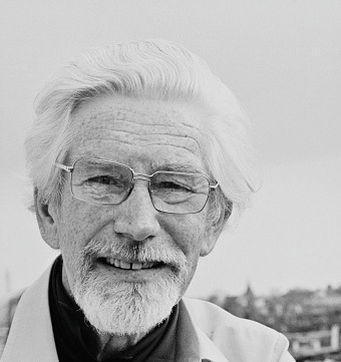
John Hillaby Reviews Jackdaw Cake (1985)
George Orwell says somewhere that autobiography is to be trusted only when it reveals something dreadful. Almost any sort of life when viewed from the inside consists largely of a series of defeats.
About the Author
John Hillaby (24 July 1917 – 10 October 1996) was a British travel writer and explorer. His real impact on the literary scene came in 1964, when he published Journey to the Jade Sea, an account of his 1,000-mile walk with a camel train through northern Kenya to Lake Turkana. The book set the pattern for his later books, Journey Through Britain (1968), an account of his walk from Land's End to John o' Groats, Journey Through Europe (1972) and Journey Through Love (1976). - The London Standard, Wednesday, October 9, 1985—21
Lewis gunner
By John Hillaby
George Orwell says somewhere that autobiography is to be trusted only when it reveals something dreadful. Almost any sort of life when viewed from the inside consists largely of a series of defeats.
By that tally alone, Norman Lewis’s book is a tremendous slice of grim-stuffed autobiography. If you didn’t know the author’s track record you might wonder how this gaunt, hawk-nosed slow-burn managed to overcome so much to become what he is today: a prince among travel writers dedicated to causes of injustice.
The title needn’t detain us. It’s very Welsh. It’s the bible thumpers’ repudiation of earthly lusts. But Mr Lewis, thank God, is very Welsh. And lusty, too, differing only from thousands of his fellow countrymen in being able to put his Celtic intuitions to unblinkered use.
Trance
Born in Enfield, he was shipped off to more than barmy relatives in Carmarthen to help him tide over Job-like succession of family tragedies. His own two brothers died rather dreadfully. His father an intelligent, likeable man ‘had the sight’. At most inappropriate times (such as his son’s wedding feast) he was apt to go into a trance to get spiritual messages from above or below.
In very Welsh-Wales “full of ugly chapels, of hidden money, psalm-singing and rain”, his randy grandfather “blooded” fighting cocks by inducing them to eat their own clipped-off head appendages. And he kept a parrot reduced to making small squeaky farts of protests.
Hideously scarred Aunt Polly, an epileptic, alternated between falling into the fire, the river or, once, from a window; and all Aunt Li could do was weep and pray. There were their seaside neighbours who stoned the poverty—stricken, holiday-making miners families, for poverty was the wages of sin, was it not?
Back in Enfield, Mr Lewis grew up; he raced old Bugattis and married the daughter of some eccentric Mafiosi before he started to tour the world on the trail of the oppressed from China to Brazil by way of Vietnam.
In North Yemen we have him awaiting the pleasure of the Imam Yahya. The delay had arisen because a prisoner awaiting public execution was reluctant to gratify His Majesty with the customary confession. It was brought about by tying up the man’s penis before they forced him to drink a great deal of water.
But it is as an Intelligence officer with the Allied forces in North Africa, Italy and, later, in Russia that the author’s terrible story achieves its delayed orgasm. What infamies were perpetrated there in the name of victory? He tells us, plainly.
The author’s style is very much his own: lilting Welshified English until the narrative is suddenly punctuated with Lewis gunning and lightly buried explosives. Lewisite, of course.

Memories of an Indulgent Burma
I am probably one of the few persons to have been tipped by a taxi driver, instead of the normal reverse transaction being the case. It was a small matter, yet provided an unforgettable moment of illumination of a cultural and spiritual divide between the East, as represented by Burma, and the West.
I am probably one of the few persons to have been tipped by a taxi driver, instead of the normal reverse transaction being the case. It was a small matter, yet provided an unforgettable moment of illumination of a cultural and spiritual divide between the East, as represented by Burma, and the West. The Driver, affectionately known locally as Oh-oh, charged reasonable sums for ferrying Burmese passengers in his canary-coloured taxi about the southern town of Moulmein, but offered his services free to foreigners deposited there for a day or two when the ship from Rangoon put into port. Most of these fares, Oh-oh had heard, were enjoying a temporary escape from the capital, where visits into the surrounding countryside were not permitted. Like so many of his countrymen he was constantly on the alert for an opportunity to acquire merit, and being kind to foreigners came under the heading of meritorious actions. Where the Menam tied up, the yellow jeep would be seen waiting on the quay, with Oh-oh offering a free ride to the new arrivals to any part of the town, plus a visit to the pagoda at Mudon, a few miles away, if the road happened to be clear of insurgents.
At the end of such trips passengers received a small present in the form of an ornament cut from mother-of-pearl. In my case the gift was a superior-quality bird’s nest. We had visited the caves where the earliest of the season’s nests were being collected, and this was the first ‘number one’ of the day. It had probably been finished only the day before, and was therefore spotlessly clean—a tiny amber saucer constructed from collector gained merit, too, by giving it away, and we shook hands and he congratulated me with a wide smile when Oh-oh passed it over.
Oh-oh now proposed that we should take breakfast—it was by this time midday—by joining a party given by a local family to celebrate the entry of their son into the Buddhist novitiate. We found ourselves in a large hall in which we joined about 200 people seated upon mats on a polished floor. Oh-oh assured me that our host had collected many of the guests at radom off the streets. Girls dressed in old-style finery were going round distributing snacks pickled tea-leaves, salted ginger and shredded prawns. Once again merit-gain was what mattered, and it was an occasion for the family to give a substantial portion of their possessions away. It might take them tow years, Oh-oh thought, to settle the debts incurred by this entertainment.
It was Oh-oh who warned me, when I told him of my hope to travel in the interior of the country, that I should do something to modify the extreme pallor of my skin. “They will not stare because they are polite,” he said, “but the young people in the villages have never seen an Englishman before and they will believe you are Japanese. We are entertained by bad memories of these people.”
“What can I do about it?”
“You can make your face darker by keeping it as much as you can in the sun.”
I this warning seriously, and after three days’ exposure as suggested on the deck of the Menam, my skin was the colour of freshly cut mahogany, except for white circles left by the sunglasses round the eyes. This caused some amusement among the European passengers, but evoked the sympathetic concern of the Burmese, one of whom being the assistant purser, who confided in me his belief that I was the victim of witchcraft.
There was no outright prohibition on foreigners travelling in the interior of Burma at this time, six years after the conclusion of the Second World War, but those who arrived in Rangoon found that such were the obstacles encountered in their efforts to do so that they soon gave up. When I presented my letter of the introduction to U. Thant, head of the Ministry of Information, he saw no reason why I should not go where I wished. Later he admitted that, this being his first experience of a request to travel in the country, he was not sure of the office procedure to be followed. Later still I was to be informed that the US Military Attache had fared no better and that a team sent by Life magazine to do a picture reportage had left after two uninteresting weeks spent in the Strand Hotel, Rangoon.
The days slipped away while I was passed from office to office, handled always with wonderful courtesy, encouraged in my hopes and commiserated with upon my many frustrations. Escape was by the greatest of flukes. Someone told me that a certain powerful general was the only person who could do anything for me. I was admitted to his office to be received by a man overflowing with charm. My face was by this time covered in blisters, but whatever surprise he may have felt at this spectacle, nothing of it showed. The fluke consisted in his occupation at the moment of my arrival with the translation of a recently issued British military manual into Burmese, and this difficulties he had run into, for although he had been at Sandhurst, certain terms employed had since been changed.
“Happen to know anything about this kind of thing?” he asked, and amazingly enough I did. One hour later I left his presence with the pass in my pocket that was open-sesame to any part of Burma. “Damn interesting trip, I should imagine,” he said. “Won’t find it too comfortable, I think, but have a great time.”
The question was where and how to travel at a time when the Burmese army was at grips with give different brands of insurgents in the provinces, and the small town of Syriam, just across the river from Rangoon, was under attack by dacoits. The disruptions of war had left a gap of a dozen miles in the main line connecting Rangoon with the old capital, Mandalay, and steamers using the Irrawaddy to carry goods and passengers up-country were sometimes cannonaded. Travelling rough could still be undertaken on the lorries of traders generally supposed to have come to an arrangement with insurgents bands, but there was nowhere in the interior to stay, not even a single hotel, and the dak bungalows providing rough accommodation in the past were closed or had been destroyed.
Happily Mandalay could still be reached by plane, and two days later I landed there, to be met by Mr Tok Gale of the British Information Service, who told me that he had arranged for me to sleep in the projection room of the town’s only cinema, and would do his best to find a seat for me on a lorry going north. I was astounded to hear that he lived in what was officially described as the town’s dacoit zone, two miles away. Tok Gale instructed me in the protocol of travel by Burmese lorry. Drivers, present them with small gifts, and he suggested that I should carry such items as key-rings and plastic combs. Postcards of the coronation of George VI were also these. “You will be seated next to the driver,” he said. “Please take trouble to compliment him on his driving warning. “Beware in conversation of disparaging dacoits. These persons may be respectable dressed and mingling unobserved with lawful passengers.”
The night of my arrival in Mandaly, while walking in the deserted main street, I was attacked by a pariah dog, which bit me calmly and quietly in the calf before strolling away. Fortunately the only place of business open was a bar, where I bought a bottle of Fire Tank Brand Mandalay Whisky to disinfect the wound. I increased my popularity on the next legs of the trip by sharing the remainder of this with such of my companions who were not subject to a religious fast. From this experience I learned the usefulness of religious fasts when rejecting unappetising food, such as the lizards in black sauce served in the north of Burma in roadside stalls.
The first stretch of the journey was to Myitkyina, where the road came to an end in the north, followed by a route virtually encircling the north-east, through Bhamo, Wanting—almost within sight of China—and Lashio, then weeks later back to Mandalay. At Bhamo, in jade country, you could pick up beautiful pieces of jade for next to nothing, and to my huge delight a circuit house for travelling officials (although there were none) was actually open, run by a butler straight out of the Victorian epoch, who addressed me as ‘honoured sir’, instantly provided tea with eggs lightly boiled, and later a bed with sheets.
A final adventure was protective custody, into which I was taken in the small town of Mu-Se. Once again I slept contentedly, this time in a police station, and by day was accompanied by a heavily armed policemen, who was as much interested as I in wildlife and natural history, on pleasant country walks.
Thereafter all was plain sailing. Children had long since ceased to be alarmed by my ravaged features, and pariah dogs were no longer perturbed by an alien smell. At Bhamo again, I took the river steamer down the Irrawaddy to Mandalay—a pleasure-making excursion, as the man who sold the tickets described it, and he was absolutely right. For three days we chugged softly through delectable riverine scenes. We were entertained by a professional story- teller, musicians strummed on archaic instruments, and once in a while the girls put on old-fashioned costumes to perform a spirited dance. There was a single moment of drama that was more theatrical than alarming. Insurgents hidden in the dense underbrush at the water’s edge fired a few shots. Those on deck took momentary refuge behind the bales of malodorous fish piled there. No one was hurt and by the time I arrived on the scene from below, our military escort, who had blasted away at nothing in particularly, had put down their guns and gone back to their gambling.
Next day Tok Gale welcomed me back in Mandalay.
“No complications with journey, I am hoping? No bad effects from meeting with dog?”
“None at all. Everything went off perfectly. Couldn’t have been better.”
“I am relieved. Well at least something will be done now about all those dogs on our streets.”
“So, you’re actually getting rid of them then?”
“For a while, yes. Abbot U Thein San is taking all these animals into his pagoda compound for feeding and smarten-up. The will be released in a better grame of mind. It is belief that they will give no more trouble. In Mandalay we are used to seeing them. We should be regretful to miss their presence.”
“It’s sto be understood,” I said.
“So how are you planning return to Rangoon?” he asked.
“I’m taking the train.”
Tok Gale seemed doubtful about this. “For train travel they are saying that things are worse than they were. “Rangoon train never arrives at destination.”
“I’ve been hearing that, so I took the precaution of having a horoscope done at the stupa of King Pyu Sawhti.”
“Ah yes. This is famous monarch hatched from egg. And was result satisfactory?”
“Entirely so. The ponggi told me I was good for another thirty years.”
“Well, that is splendid omen,” Tok Gale said. “So 6.15 to Rangoon is holding few terrors for you?”
“How can it after a horoscope like that?”
Tok Gale laughed and shook his head in mock reproach. “Now I must tell you something, Mr Lewis. You are falling into our ways.”
Norman Lewis on Naples
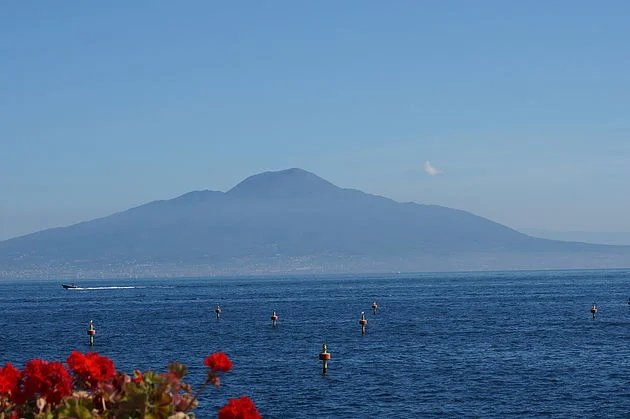
Today Vesuvius erupted. It was the most majestic and terrible sight I have ever seen, or ever hope to see. The smoke from the crater slowly built up into a great bulging shape having all the appearance of solidity. It swelled and expanded so slowly that there was no sign of movement in the cloud which, by evening, must have risen thirty or forty feet into the sky, and measured many miles across . . .
All photos by Fiona Byrne
Today Vesuvius erupted. It was the most majestic and terrible sight I have ever seen, or ever hope to see. The smoke from the crater slowly built up into a great bulging shape having all the appearance of solidity. It swelled and expanded so slowly that there was no sign of movement in the cloud which, by evening, must have risen thirty or forty feet into the sky, and measured many miles across.
- On the eruption of Vesuvius (Naples '44)
Fear is expressed that the blood of San Gennaro may refuse to liquefy this year, and that such a failure might be exploited by a secret anti-Allied faction and troublemakers to set off large-scale rioting of the kind that has frequently happened in Neapolitan history when the miracle has failed. Everywhere there is a craving for miracles and cures. The war has pushed Neapolitans back to the Middle Ages.
- On the mircale of San Gennaro (Naples '44)
Neapolitans take their sex lives very seriously indeed. A woman called Lola, whom I met at a dinner party given by Signora Gentile, arrived at HQ with some denunciation which went into the waste-paper basket as soon as her back way turned. She then asked if I could help her. It turned out she had taken a lover who is a captain in the RASC [Frazer], but as he speaks no single word of Italian, communication can only be carried out by signs, and this gives rise to misunderstanding.
She had made him understand by gestures one could only shudderingly imagine that her late husband—although half-straved, and even when in the early stages of tuberculosis from which he later died—never failed to have intercourse with her less than six times a night. She also had a habit, which terrified Frazer, of keeping an eye on the bedroom clock while he performed. I recommended him to drink—as the locals did—marsala with the yolks stirred into it, and to wear a medal of San Rocco, patron of coitus reservatus, which could be had in any religious-supplies shop.
- On the sex lives of Neopolitans (Naples '44)
Until now I had clung to the comforting belief that human beings eventually come to terms with sorrow and pain. Now I understood I was wrong, and like Paul I suffered a conversion—but to pessimism. These little girls, any one of whom could be my daughter, came into the restaurant weeping, and they were weeping when they were led away. I knew that, condemned to ever-lasting darkness, hunger and loss, they would weep incessantly. They would never recover from their pain, and I would never recover from the memory of it.
- On pain and suffering during in Naples (Naples '44)
In Naples there are no baby-sitters: the family takes its pleasures and suffers its tribulations as a unit, and the aged are excluded from none of its experiences.
- On the Neopolitan family (A View of the World)
In Naples there is human solidarity hard to find elsewhere. If one lives there long enough one has the sensation almost of belonging to the world’s most enormous family.
- On Neopolitan solidarity (A View of the World)
Of all the great cities Naples has suffered least at the hands of that destroyer of human monuments, the dark angel of development. Pliny himself, who once stood on a headland there to watch the great eruption of Vesuvius ‘shaped like a many-branching tree’ in the moment of obliteration of Pompeii, would have little difficulty in picking out the landmarks of our times.
- On the antiquity of Naples (A View of the World)
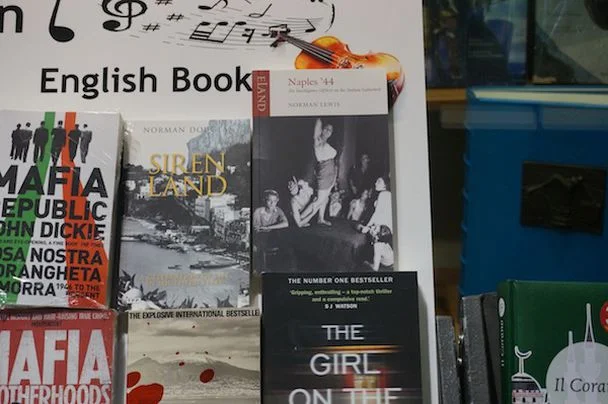

Martha Gellhorn on Naples '44
On an early Monday evening in November Norman and Lesley made a rare trip to London together. The occasion was a birthday party at the Groucho Club for Martha Gellhorn, a few month younger than Norman. Both were now eighty-five. Lesley recalls that the dinner was "fascinating. Her coterie of young men [was there], John Simpson, Jon Snow, Nicholas Shakespeare, John Hatt. It was predominately a male occasion." Gellhorn had been asked, as had Norman, by the Daily Mail to write a piece about her best of all time travel book for its New Year's Day edition, and told him she had chosen Naples '44.
From Semi-Invisible Man by Julian Evans:
On an early Monday evening in November Norman and Lesley made a rare trip to London together. The occasion was a birthday party at the Groucho Club for Martha Gellhorn, a few month younger than Norman. Both were now eighty-five. Lesley recalls that the dinner was "fascinating. Her coterie of young men [was there], John Simpson, Jon Snow, Nicholas Shakespeare, John Hatt. It was predominately a male occasion." Gellhorn had been asked, as had Norman, by the Daily Mail to write a piece about her best of all time travel book for its New Year's Day edition, and told him she had chosen Naples '44.
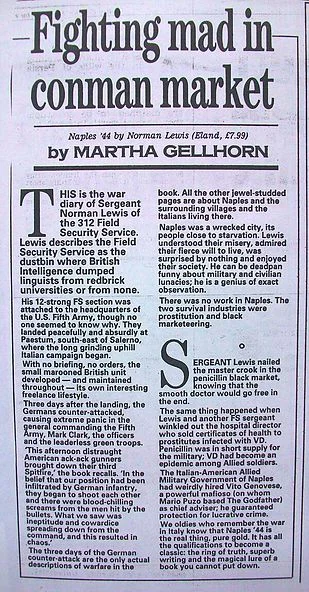
Fighting mad in conman market
Naples '44 by Norman Lewis (Eland, £7.99)
by MARTHA GELLHORN
THIS is the war diary of Sergeant Norman Lewis of the 312 Field Security Service. Lewis describes the Field Security Service as the dustbin where British Intelligence dumped linguists from redbrick universities or from none. His 12-strong FS section was attached to the headquarters of the U.S. Fifth Army, though no one seemed to know why. They landed peacefully and absurdly at Paestum, south-east of Salerno, where the long grinding uphill Italian campaign began.
With no briefing, no orders, the small marooned British unit developed—and maintained throughout—its own interesting freelance lifestyle.
Three days after the landing, the Germans counter-attacked, causing extreme panic in the general commanding the Fifth Army, Mark Clark, the officers and the leaderless green troops.
"This afternoon distraught American ack-ack gunners brought down their third Spitfire," the book recalls. "In the belief that our position had been infiltrated by German infantry, they began to shoot each other and there were blood-chilling screams from the men hit by the bullets. What we saw was ineptitude and cowardice spreading down from the command, and this resulted in chaos."
The three days of the German counter-attack are the only actual descriptions of warfare in the book. All the other jewel-studded pages are about Naples and the surrounding villages and the Italians living there.
Naples was a wrecked city, its people close to starvation. Lewis understood their misery, admired their fierce will to live, was surprised by nothing and enjoyed their society. He can be deadpan funny about military and civilian lunacies; he is a genius of exact observation.
There was no work in Naples. The two survival industries were prostitution and black marketeering.
***
SERGEANT Norman Lewis nailed the master crook in the penicillin black market, knowing that the smooth doctor would go free in the end. The same thing happened when Lewis and another FS sergeant winkled out the hospital director who sold certificates of health to prostitutes infected with VD. Penicillin was in short supply for the military; VD had become an epidemic among Allied soldiers.
The Italian-American Allied Military Government of Naples had weirdly hired Vito Genovese, a powerful Mafioso (on whom Mario Puzo based The Godfather) as chief adviser; he guaranteed protection for lucrative crime.
We oldies who remember the war in Italy know that Naples '44 is the real thing, pure gold. It has all the qualifications to become a classic: the ring of truth, superb writing and the magical lure of a book you cannot put down.
Originally published in The Daily Mail, circa 1995
Anthony Burgess Reviews Empire of the East (1993)
'Empire' is undoubtedly the right technical term for a mass of sea-sundered territories ruled from a single centre. When I lived in Malaysia I was aware of Sumatra a few sea miles to the west; when I was in Brunei (which on Norman Lewis's map has, with Sabah, been swallowed by Sarawak) I was to the north of an unexplored mass of jungle that belonged to Indonesia.
Taken from The Observer: 17.10.93
Fruit bats, blood soup
'Empire' is undoubtedly the right technical term for a mass of sea-sundered territories ruled from a single centre. When I lived in Malaysia I was aware of Sumatra a few sea miles to the west; when I was in Brunei (which on Norman Lewis's map has, with Sabah, been swallowed by Sarawak) I was to the north of an unexplored mass of jungle that belonged to Indonesia.
Indonesia was welcome to it. Indonesia was a mess and still is—sloppily or tyrannically ruled from Jakarta, way down south in Java; not better governed by the Dutch than by the men of Malay stock who took over. What Jakarta did with Washington's approval to East Timor (curious tautology—Timor means East), remembered in Lewis's fine book, goes well with the atrocities of Pol Pot. Hitler and Stalin might well have looked up from hell with approval at President Suharto.
The doyen of English travel writers, Lewis must now be pretty old. It was courageous of him to make the trips he did— through Sumatra, East Timor and Irian Jaya—the most eastward of the Indonesian territories (600 miles south you touch Australia). The danger is to be found less in the people you meet than in the food they offer and the karaoke they deafen with. Lewis's daughter Claudia, having been at work on a project with homeless Javanese, had just been in Sumba eating blood soup with pig fat. Fruit bats were much cooked in Sumatra. The Tropicana, a much-praised Chinese restaurant in Banda, served pig's stomach stewed in blood, and pork in snake's gall. 'You go for alligator? Shit, we got everything.'
Lewis motored, with his son and son's friend and an obligatory guide, up to Banda Aceh in the Sumatran north. This used to be Acheh, but reformed Bahasa spelling forced you (in theory at least) to drink Chocha Chola. The philology of the Orient is as shaky as its anthropology. But Indonesia has not gone as far as Malaysia in wishing its aboriginals to be kicked into Islam. A lot of Indonesians wish to cut Muslim throats because of a Muslim habit of micturating in streams and rivers and annoying the water gods. And what can decent rational Muslims do with a land where every movement may be defilement of a taboo?
Jakarta reason has devastated the rain forests on a Brazilian scale, killing off a uniquely rich wildlife. As for the waste land, that can become Japanese golf courses. And in a new paradise in which an excess of native cultures will be reduced to tourist pokerwork, the whole empire can become an under-paid, overworked labour force.
Getting to East Timor was difficult. No seats today or tomorrow and the waiting list is full. It seemed that there was some dirty secret to hide. Police scrutiny was in tense and there was a powerful military presence. The filth went back to 1975, when, after a meeting in Jakarta between Suharto, President Ford and Henry Kissinger, which the State Department called 'The Big Wink', Indonesia invaded the Portuguese territory of East Timor. The slaughter of probably a million Timorese, on the grounds that they were communists, still seems incredible.
Lewis's Portuguese was better than his Bahasa, but it was a dangerous language to use. Picking up the keys to his room, he let the word obrigado slip out. This nearly caused a riot. Only his taxi driver had the guts to cry 'Vivan os cornpanheiros!'.
His journey to Irian Jaya was less perilous, although his missionary pilot told him that there were probably still cannibals in the district. Lewis visited a Yali tribal community living in a stone age culture some ten thousand years old. The men were naked except for a penis gourd. Their solemn greeting was 'I honour your faeces'. There is a curious analogy here with the Malaysian protocol of addressing the dust under the Sultan's feet. Everybody coughed, and life was a bore mitigated by the weekly church service.
The Yali could not be expected to join in one of the most incredible feats of mining ever seen—the Ertzberg mountains in the highlands of Irian Jaya have been found to contain a body of copper, silver and gold that continues to be removed at the rate of 24,700 tonnes a day. Meanwhile, the native population have been forced to surrender 10,000 hectares of their land for which no compensation has been paid. And yet the Indonesian Constitution guarantees that' the earth, the waters, along with the natural resources contained therein, shall be regulated by the government, and are to be used to promote the utmost welfare of the people’.
Whatever government Indonesia has had, it has always been corrupt, cruel and mendacious. Mr Lewis has, with his inveterate skill, presented these purgatories with a light touch. His prose is almost edible. In old age he is writing better than ever.
View scan
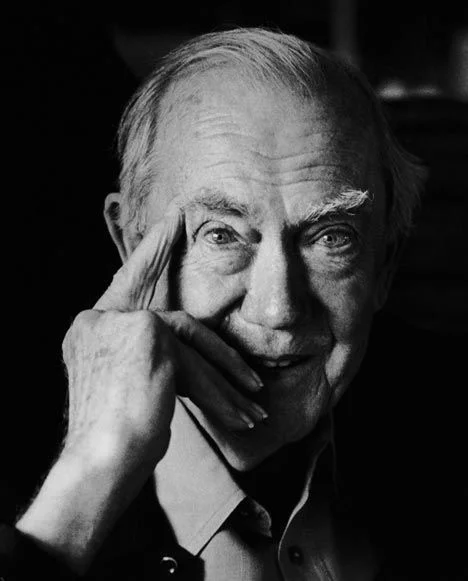
Graham Greene
Anybody who cares to research Norman Lewis will, in numerous articles, find references to Graham Greene, the novelist and traveller, who once described Lewis as one of the great writers of the twentieth century. Journalists since the 1950s have noted a similarity between the two authors, in particular their penchant for incorporating exotic locations into their fiction. But few have explored the ways in which Greene and Lewis might have influenced one another’s writings. For some readers, it is perhaps more plausible to think that Greene, by far the more popular of the two, influenced Lewis rather than the other way around. Yet there are a number of sources that suggest that Greene might just as easily have been influenced by Lewis.
Although they never properly met in person, Greene wrote to Lewis in 1986, shortly after the publication of A View of the World, a collection of Lewis’s travel journalism. Greene had spotted two errors in the book, but admitted that, by writing to correct them, he had finally given himself the perfect excuse to express his great admiration for Lewis’s works. In his final paragraph, he went on to note how similar their paths had been: Laos, Vietnam, Belize, Goa, Liberia, Panama and Cuba, where years ago, while Greene was writing Our Man in Havana, they had observed one another from across the room of what Lewis called a “ghastly American blue-lit bar”.
“I never spoke to him,” he said decades later, though he was apparently aware of Greene’s presence in the corner.
Greene liked to keep a low profile. When the writer Bruce Palling wrote to him asking him if he would consider writing an introduction to the Eland edition of A Dragon Apparent, Greene wrote back a puzzled A5 letter saying:
Dear Palling, Yes, I have fond memories of Indo-China. A Dragon Apparent? I’ve never heard of it. What is it?
And yet it’s hard to believe that Greene wasn’t aware of this book, especially considering how familiar he seemed to be of Lewis’s other works. On another occasion, in a letter to John Hatt, the founder of Eland, Greene wrote of the “tremendous pleasure” he got from reading Naples ’44; and contrary to the impression Greene gave in his letter to palling, it is James Fenton’s suggestion that A Dragon Apparent might even have inspired Greene to visit Vietnam:
People used to say at the end of the Vietnam war that Graham Greene’s novel The Quiet American had foreseen everything that would follow. But Lewis was there before Greene and you wonder whether Greene had read Lewis’s book and thought, This place sounds interesting.
Although he never wrote a foreword for A Dragon Apparent, Greene did review Lewis’s book The Missionaries for The Weekend Telegraph in 1988, and was even kinder in print than he had been two years earlier in his letter. He had only one overt criticism of the book: he felt that the title could have been more precise (The Evangelists, he felt, might have been more suitable), since the book deals entirely with the horrifying activities of the American evangelists in the Third World. But it is unlikely that Lewis would have been very disappointed to hear this; Greene’s review was otherwise extremely positive.
Many great writers praised Lewis during his lifetime, though I suspect that this review, more than any other, meant a great deal to Lewis because it was written by somebody he respected. Nicholas Shakespeare once wrote how each writer has his or her own scent, and that if he had to describe Greene’s, it would be the smell of something being taken off a clothes line after being battered by the wind. “Something clean, outdoors, kinetic.” I think that this same description applies to Norman Lewis, for his, too, is a style that owes something to clean precision: lean and lucid and written in a way in which every word seems to have been carefully considered. And though both writers had very much their own voice, it is easy to see why both men, known for their privacy, admired one another.
– Jack Sharp
La Résidence des Fleurs,
Avenue Pasteur,
06600 Antibes
9th June 1986
Dear Norman Lewis,
There is always the tiresome reader who corrects an error, and this time I am the tiresome reader as it gives me the excuse for expressing my great admiration for your works.
And the error? In A View of the World you have Jaurès assassinated in the Chambre des Deputes—he was killed in the Café’ d[u] Croissant in Montrmartre. You speak of the assassin Villain being “quietly released”. He was tried for murder in 1919 and acquitted by a packed bourgeois jury and 150,000 people met, urged on by Anatole France the next Sunday to protest against the verdict.
Forgive this tiresome reader and admirer. Our paths seem strangely similar—Laos, Vietnam, Belize, Goa, Liberia, Cuba, Panama.
Yours Sincerely
Graham Greene
WEEKEND TELEGRAPH, SATURDAY, MAY 7, 1988
At God's mercy
THERE IS something a little absurd in the habit among journalists of dividing our century into literary decades, as though books went out of date like women's clothes.
No critic in the 19th century would have referred to Trollope as a writer of the '60s or the '70s, and I have no hesitation in calling Norman Lewis one of the best writers, not of any particular decade, but of our century. His work, I hope, will be fully appreciated during the '90s which already cast a shadow.
Of his latest book, The Missionaries, my only criticism is of the title, which I would have preferred to be more precise, The Evangelists, for it deals almost entirely with the horrifying activities of the American evangelists in the Third World where they are destroying native cultures, not in the service of any genuine faith, but in the service of American capitalism and sometimes in that of the CIA.
My criticism of the title comes from my own experiences, which have all been with very different missionaries—like the Fathers in a leper colony in the Congo where the health of their patients was their main concern, not their faith or even their morals; or that solitary priest whom I encountered outside the camp of Dien Bien Phu living alone in a hut, without a parish or a congregation.
He had been tortured by the Japanese and bore the scar of a Vietminh wound. His business was not conversion-there were few Christians in Laos. He offered only medicine and friendship to anyone who passed his way.
In recent years we have found it easy to laugh at the American television evangelists and their sexual adventures and the odd names of their various so-called sects (I once counted 63 of them in the Panama Zone telephone directory, including one called Coco-Sola, if I remember correctly), but until I read Mr Lewis's remarkable book I had no idea of the danger to human life which they represent.
Twenty years ago Mr Lewis wrote an article on much the same subject called "Genocide: Brazil" which led to changes in the Brazilian law. One can only hope that this more extensive study will drive even some of the dictators, whom the United States government has been happy to support, into at least mitigating action.
Take for example the New Tribes Mission run by a Mr Stolz for the spiritual benefit of the Aches in Paraguay. Donald (Mr Lewis's photographer) "strolled off towards two huts" on the outskirts of the Mission.
A smiling young missionary overtook them and barred the entrance to the first of the huts, saying there was nothing there. Donald pushed him aside, went in and came back to call me. I followed him into the hut and saw two old ladies lying on some rags on the ground in the last stages of emaciation and clearly on the verge of death. One was unconscious, the second in what was evidently a state of catalepsy, because although her eyes were wide open she did not move them to follow my hand as I moved it from side to side close to her face. The fingers on her left hand were covered with the black mud scrabbled from the floor. There was no food or water in slight.
In the second hut lay another woman, also in a desperate condition with untreated wounds on her legs. A small, naked, tearful boy, sat at her side. Mr Stolz's son, happy to help with the tripods and handing up spare lenses, gave us a matter of fact account of what had happened. The three women and the boy had been taken in a recent forest round-up, the third woman having been shot in the side while attempting to escape.
Mr Stolz was supported by the government of Present Strossner who is trusted by the White House as a strong opponent of a non-existent Communist menace. Here are Mr Stolz's spiritual views:
"There is no salvation, " he said, "for those who cannot be reached. The Book tells us that there are only two places in the hereafter: heaven and hell. Hell is where those who cannot be reached will spend eternity."
An equally well supported mission in Bolivia has the strangely unreligious title of the Summer Institute of Linguistics. This operates under the guidance of a Mr Victor Halterman, believed by all the Bolivians whom Mr Lewis met to be running a base for CIA operations as well as ensuring the spiritual salvation of the Indians. His theology was in agreement with the doctrinal statement of the New Tribes Mission: "We believe in the unending punishment of the unsound." He admitted to Mr Lewis that "we have a very limited medical programme."
Reading Mr Lewis's book, my thoughts could not help returning to that very different Mission in the Congo where the priests looked after the body and left the souls of their patients, and themselves to the mercy of a God in which the evangelists show little signs of believe.
By Graham Greene
References
- Semi-Invisible Man by Julian Evans
- Weekend Telegraph Saturday, May 7th, 1988
BBC2 Arena: The Journey Man
THEY CHANGE THEIR SKY, not their soul,' as Horace said, 'who run across the sea.' The sad old Roman truth is not to be refuted. Escape is never more than partial. Nevertheless, at a minor geographical level small, reviving evasions can be planned. This one was to Spain, an unlikely bolthole, it might be supposed, in the era of the package deal; yet far from the Costas in the deep interior rich lodes of undisturbed hispanidad remain to he discovered . . .
From Time Out (23 Jan '86):
Documentary about Norman Lewis, prolific travel writer and recent autobiographer, whose Jackdaw Cake revealed one of the most bizarre upbringings in recent English history. This film is more anecdotal than biographical and as such, is fascinating. Lewis is such an unassuming, lugubrious man whose qualities as a travel writer should serve as a blueprint for anyone wanting to start: he possess a self-confessed 'fascination with customs, sense of history and an eye for the small details of life. Plus an abnormal quota of curiosity and quite a sense of adventure.' Working colleagues Don McCullin reckons he's achieved so much through 'not being loud or agressive.' 'Arena' concentrates on Lewis' book 'Naples 44, written while working as an intelligence officer in the city, but also manages to draw Lewis into other areas: the tribal Indians, for example, who are his 'ideal human beings'. Lewis is now in his 70s — I'd be pleased with a tenth of his success, his knowlege and his modesty at that age.
This programme was directed by Tristram Powell.
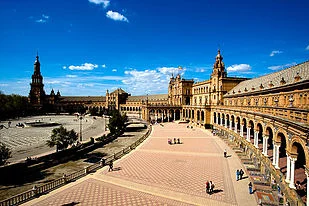
'Another Spain' Taken from To Run Across the Sea by Norman Lewis
THEY CHANGE THEIR SKY, not their soul,' as Horace said, 'who run across the sea.' The sad old Roman truth is not to be refuted. Escape is never more than partial. Nevertheless, at a minor geographical level small, reviving evasions can be planned. This one was to Spain, an unlikely bolthole, it might be supposed, in the era of the package deal; yet far from the Costas in the deep interior rich lodes of undisturbed hispanidad remain to he discovered . . .
THEY CHANGE THEIR SKY, not their soul,' as Horace said, 'who run across the sea.' The sad old Roman truth is not to be refuted. Escape is never more than partial. Nevertheless, at a minor geographical level small, reviving evasions can be planned. This one was to Spain, an unlikely bolthole, it might be supposed, in the era of the package deal; yet far from the Costas in the deep interior rich lodes of undisturbed hispanidad remain to he discovered.
In preparing such an evasion simple rules are to be followed. Bring or hire a car, avoid great cities, travel by second- or third-class roads, make for the remoter parts of the south and west which are too far from anywhere to have made it worthwhile setting up industries. Here, where there has been no money to spend on development, the old Spain stubbornly survives. Rare and extraordinary flowers flourish in hedgerows that have never been reached by sprays. Towns bat with the proceeds of the plunder of Moorish kingdoms, or of the Indies, remain intact. The best of them offer no accommodation for the traveller except occasionally a government parador. By way of a bonus, some of the latter are housed in grand buildings: castles, old convents, Renaissance palaces. It is normal, too, for thorn to be sited in areas of outstanding historic interest.
Carmona comes under this heading. It is a two days' drive by the slow roads from Valencia, Alicante or Madrid. When Seville is en fete—as this alluring and anachronistic town is during most of the spring and summer—and there is not abed to he had, Carmona supplies a small-scale and concentrated alternative. It is full of tremendous churches, the scent of incense, and scuttling nuns. Its window grilles, coming right down to the pavement, symbolise the Andalusian exclusion of the world from private affairs, and within the house—since shutters remain closed the gloom Alexander Dumas noted as characteristic of these southern interiors, persists until lamps are lit or switched on at night.
Apart from palaces and churches, Carmona possesses no fewer than three Moorish fortresses, whose rod walls spread russet light through the streets like the glow beneath chestnuts in autumn leaf. Kestrels by the dozen hang pale and translucent in the sky over church towers that were once minarets, appearing like tiny kites manipulated by invisible strings. The principal fortress is the Alcdzar del Rey Don Pedro, favourite abode in his kingdom of Pedro the Cruel. From what is now the parador this fearsome monarch —only to he recognised in his disguise by the clicking of his arthritic knees — stole out at night to pick a quarrel with and assassinate any defenceless subject who happened lobe abroad. It was here in 1492 while awaiting the fall of Granada that Ferdinand and Isabella sat side by side on their thrones to hand down the ferocious edicts by which the conquered territories were to be governed. This was a bad time to be on the losing side. King Ferdinand the Saint, whose self-imposed penances brought about his own death by dropsy and starvation, converted the Muslim survivors in this town after its conquest. Magnanimous by the standards of his day he spared those who hulled promptly to Christ. Where conversion was proved later to have been insincere, backsliders were burned in batches, the king himself frequently applying the torch to the faggots after first implanting the kiss of forgiveness upon the cheeks of those about to suffer.
Zafra is a two-hour drive away up the Estremadra highway to the north. This small, bewitching town is frequently called Little Seville, due, it is supposed, to the settlement there in the past of Sevillians seeking escape from an over-severe religious climate and its all too frequent auto-dales . Here the refugees built themselves mansions in the style of their home town: white, with baroque embellishments over windows and doom painted with the unique and costly chrome-yellow pigment derived from the soil of Alcala de Guadaïra, a few miles away. This, according to local belief, not only cools the heat of the summer sun and warms the chills of winter, but possesses also talismanic qualities against the spells of witchcraft.
Like Cannona it is a town with a brilliant Andalusian surface and dark, secretive interiors. In true Andalusian style, its people lead frugal lives, are calm and slow in their movements, conduct their business transactions verbally, and settle them without written contract. Dignity is regarded as a principal virtue, and life's targets are kept simple. Any Seville, ceramic well plaques are sometimes used to set forth the philosophy of the owner of a house. Several in Cannona enjoin kindness to birds.
Spaniards regard this town's alcazar, in which the parador is incorporated, as one of the country's most imposing, and with this I would agree, although it is smaller than most. It was built in 1443 at a time when, with the strengthening of the central government's grip, private military enterprises of this kind were becoming obsolete. In effect, this was the town house of a rich nobleman who set out to impress his friends, for, with the front line of the war against the Moors a hundred miles away, it was unlikely ever to be required to withstand enemy attack. Nor with its make-belief Moorish-style decorative battlements, its slender towers, its elegant but not too solid keep, could it easily have done so. An exquisite Renaissance patio in white marble, by the architect responsible for the building of the Escorial was added later, further enhancing the showy domestic atmosphere of the place. It is in this setting that guests are splendidly lodged.
The parador is pridefully named after the conqueror of Mexico, Hernando Cortes who stayed some months here at the invitation of his patron, the Duke of Feria, before his departure for the New World. Cortes, understandably, has remained a local as well as national hero, the more so because—as with the rest of the conquistadors—he was an Estremarnuan man and, like most of them, of obscure and bumble origin. The picture of him to be seen here presents an imperial figure indeed. As was the custom at that time, he had been given the great man's face of the day, based upon that of the Emperor Charles V, though modified by some slight tinkering with the features, and in particular by the correction of the pendulous Hapsburg lip. There is a mystery here, for in 1947 the Mexicans announced that the conqueror's remains had been exhumed in Mexico City. What had been found was described as the skeleton of a hump-backed dwarf, with a right arm withered into uselessness through syphilitic infection. Such are the deceits concealed in history.
From this point on, the road leads northwards through Merida and Trujillo and then to the east into the centre of Spain. In doing so it skirts an area of roughly 23 poo square kilometres where hardly any changes have been made to the map for half a century. George Borrow, prospecting for souls in the back-lands, where be thought the 'Genuine Spaniard' was most likely to be found, came here to distribute his bibles on his 'sorry mule, covered with sores, and wall-eyed'. He would have no difficulty in recognising these villages as they are now, for, notwithstanding the prosperity based upon the tourist industry of Spain's eastern seaboard, and of cities such as Barcelona and Madrid, Estremadura remains isolated and impoverished, suffering moreover from the draining away of its human life's blood through emigration to France and to the Spanish towns.
Narrow winding lanes bring the traveller eventually to Guadaloupe, a town of great charm with old wooden and half-timbered houses, clustered round the monastery-fortress that provides its raison d'etre. It is near enough to the geographical centre of the country to have served for a short time as the seat of government, before the establishment of the capital at Madrid. The Catholic Kings, enthroned as stiffly as figures in cathedral stained glass, held court here, issuing royal licenses for voyages of discovery or conquest to the New Weald, attracted to Guadaloupe not only by its location but by its reservoir of undiluted faith.
Guadaloupe's position in the forefront of Christian revival and endeavour was achieved following a sign from heaven shortly after its liberation in battle from the Moors. The Virgin Mary appeared to a countryman, instructing him to dig in a cave, where an image of her, bidden away from the invaders back in the eighth century, would be found. This he did, the image was recovered and a shrine set up. There followed a series of prodigious happenings of a rustic, homely kind. Asses reproached their masters for their ill-treatment in good Castilian, levitation was commonplace, and in one case a defunct cow, already in the process of being skinned, was raised from the dead. Pilgrims began to flock in.
From these beginnings them arose and grew through the centuries the enormous accretion of military and ecclesiastical architecture constituting the monastery. There are few more stunning experiences of its kind than to arrive here by night, dropping down from the black emptiness of the sierra, then, after the last hairpin bend, plunging without warning into the great spread of light from these buildings, their mediaeval banners afloat in a glowing sky.
The parador at Guadeloupe has borrowed a little history from them. It began as a hospital for pilgrims and in 1402 was issued a Papal privilege by which the first dissection in Spain was carried out, the body having been preserved in perfumed oils to which sacramental wine was added while awaiting the privilege's arrival. Its guests are housed in pseudo-mediaeval surroundings, which fail quite to measure up to those offered by the monastery itself, part of which has been converted into a hostelry. This, with the distant chanting, the aloof monks padding through the cloisters, the soft, background mutter of pilgrims' prayers, and the crashing discord of bells, is the Middle Ages.
In its venture into the hotel business the Church has been brilliantly successful, for nowhere in the province are guests lodged so splendidly, and nowhere do they eat so cheaply and so well. All are welcome and Guadeloupe is filled in all seasons with countrymen and women who have saved up for a year or two to come here for the good of their souls, and also to have the holiday of their lives. Zurbathn, master painter of Estremadura worked here. The monastery owns many of his canvases, and his saints wear the faces of those thick-fingered, black-clad p.a., who wander in small flocks round the Gothic ambulatory to admire the paintings of martyrdoms and miracles.
Guadaloupe, thriving on religious tourism, is an island of prosperity in the depressed economy of the province as a whole. Leaving it, the change is immediate and stark. The timbered skeleton of a once fine house that has shed its flesh stands by the roadside as a portent of what is to come; after that, only a single, rather miserable hamlet and piles of stones where others once existed are passed before Cijara is reached. One of the reasons for this last leg of the journey was the hope of seeing something of the Cijara region, generally known locally as the Siberia of Estremadura, due to its historically unhappy situation in the no-man's-land between warring mediaeval kingdoms. Nobody lived here unless obliged to. This, coupled with a recent acute loss in population, has been to the advantage of many rare animals and birds. Included among them are the Iberian lynx, and the Egyptian mongoose, which is not to be found elsewhere in Europe. Renowned as a last refuge of obsolescent birds is El Mum, a lakeside cliff listed as the breeding ground of three species of vulture, the Black Stork, Bonelli's Eagle and the Iberian Imperial Eagle. I was hoping to be able to visit this birdwatcher's paradise although it is several miles from the nearest road and only vaguely defined on large-scale maps.
The Siberia of Estremadura, roughly 60 kilometres across, contains four villages and a sprawling complex of artificial lakes formed by the flooding of the Guadiana Valley. When last counted, its total population was 2500, but that was ten years ago and there has been a steep decline since then. A government report devoted to its predicament mentions that the direct road from Toledo no longer touches a single inhabited place for 80 kilometres. Final desolation, then, draws near, although, clutching at a straw, the report says that emigration is slowing down, `doubtless owing to unemployment in the cities'.
Villagers without any strong ties to keep them in Cijara have pulled out, leaving those who are too old to uproot themselves, plus a hard core of devotees of the hunter-gatherer's way of life. Isolation has welded those that remain into a family group that takes a remarkably philosophic view of its situation. They are remarkably courteous and kind, even for the Spanish. When I spoke of 'people' using the normal word genre, someone administered a gentle correction. People in Cijara were vecinos, 'neighbours', and everyone, including visiting foreigners, was included in this pleasant familiarity. `Communications leave much to be desired,' said the government report. `Their economic resources are scant, and they rely almost exclusively upon game.' Game, however, was varied and abundant, and in Cijara they eat well. Partridge in saffron rice was on the menu at the bar, and tout could be fished from the lake in a matter of minutes. The bread baked here was the best I have tasted in my life.
Hopes of being able to reach El Muro faded. Unseasonably in October it had been raining for days, and the view from a hilltop was of a drenched savannah through which the Guadiana River, folio the brim, had spread curlicues of water. The news at Cijara was that the direct mad along the north shore of the lake had been cut off by floods and an extremely circuitous route round by the south, through Helechosa, might also be impassable. I was grateful for the excuse for this detour. Helechosa conducts a Corpus Christi ceremony in which children take up cudgels 10 drive 001 the homed and masked 'devils' that have invaded the village—a whispered suggestion that, despite the Inquisition's efforts, the old Manichaean heresy, once prevalent here, that God and Satan are co-eternal, may have survived.
But, when I went there in the rain, there were no children to be seen. Perhaps there were none left for, when a village faces the possibility of its eventual extinction, the children are the first to go. Beyond Helechosa the road came to an end. The Guadiana flowed across it into the lake where once there must have been a bridge and only a ravaged track corkscrewing up into the hills offered an alternative to turning back. At this point the over in spate carried red earth in suspension. A magenta stain was widening in the lake and, as I watched, a white bird folded its wings and dropped into it after a fish.
Beyond the rising water, cork oaks were meticulously spaced in the order imposed by nature in a landscape which—apart from artificial lakes had been left to itself, and the maquis was as clean-cut as a well tended garden. Within a decade or two the human presence would almost certainly be gone. I wondered if the wolves would eventually find their way back, as they had in the Sierra de In Culebra in the north which I had visited in the spring. Villages containing many old houses exist where a single family remains. In one village, Boya, all the self-supporting young had been enticed away to the discos in the towns, but most of the middle-aged hoped to stay on. It was a pleasant place, amazingly reminiscent of a village in unspoiled England, perhaps in the Cotswolds, with an ancient church on the green, merino sheep mopping the grass, and cottages with flower gardens. When the talk of wolves came up, Jaime Martinez, owner of the bar, was philosophical. 'You see one now and again,' he said, `but they don't really trouble us. They're something you can cope with. It's the wild boars that bother us. They root up everything in the gardens. You could even may the wolves are useful in a way. At least they keep the boars.
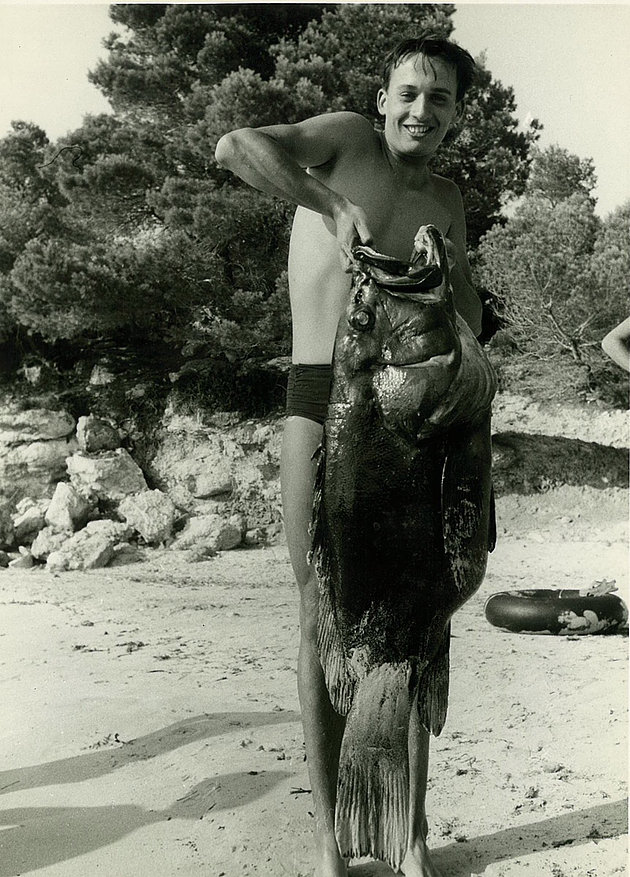
Hold Back the Crowds
I chose Farol on the Costa Brava and as it turned out spent three summer seasons there, studying and writing about the life of the people. Protected by an approach down something hardly better than a can track, followed by steep gradients and hairpin bends, and a final patch of swamp crossed by a swaying bridge, the village was perfect from my point of view . . .
I chose Farol on the Costa Brava and as it turned out spent three summer seasons there, studying and writing about the life of the people. Protected by an approach down something hardly better than a can track, followed by steep gradients and hairpin bends, and a final patch of swamp crossed by a swaying bridge, the village was perfect from my point of view. A further slight drawback to the visitor was that a spare room in a house had to be found, although in a friendly and hospitable environment this offered no difficulty. Such were these small deterrents that in the first of three incomparable seasons of my stay, there were no other intruders from the outside world and in consequence I was able to enjoy life in surroundings that had hardly changed in the previous century or two.
Apart from the priest, a shopkeeper, and a Civil Guard, the people of Farol lived wholly by fishing, and even a young doctor possessing the legal minimum of qualifications for practising his profession put in an hour or two dickering with the nets with which he caught an occasional fish. There were neither rich nor poor, and even the charming old aristocrat who owned most of the land grew on it no more than a few meagre vegetables, and stole out at night to put down pots from which once in a while he recovered a lobster. Life here, although devoid of modern stress, provided an abundance of small pleasures. The fisherman back from the sea told tall stories and composed poetry in the single bar. On Saturday nights there was dancing no a wind-up phonograph in the tiny square. Fiestas were frequent, as well as outings to accepted beauty spots and local shrines. For financial reasons courtships were protracted and marriages entered into law: in life than in the towns. Families with more than two children were rare. Above all, it seemed to me, the villagers lived in harmony. The fisherman’s calling is the least boring of professions, for however meagre the daily return, hope of great catches to come is never extinguished. Fishing where large shoals are frequently involved calls continually for communal planning and action as opposed to individual effort. In Farol, a living constructed from the sea was devoid of my taint of had blood.
I was late on the scene the next year, and by then the first of the tourists had arrived. They were two French girls who had found a room over the bar, but who soon moved on, although their brief presence left an extraordinary effect. The fisherman’s wives who spent most of their day mending nets spread out on the beach had been much impressed by their clothes, and had copied them carefully. Within a matter of weeks, still busy with torn netting, they were clad in reasonable imitations of French fashions. These, although unsuitable to the background, attracted much admiration both in Farol and in other villages in the vicinity. The accommodation over the bar had been rented at rather above-average prices, thus giving the couple who ran the place the idea of adding to their establishment an annexe with two more rooms. As soon as this was completed it was occupied by more French tourists, and a developer attracted as if by magic to the scene put in plans for a three-storey hotel.
By year three a startling change had come about. All the main highways from the frontier were now resurfaced, the potholes in the local roads filled in, the swamp drained and the bridge put in order. The new hotel‚ ‘modernistic’ in design, dominated the mild contours of the old village like an army strongpoint and was full of English and French, and the foundations of two new hotels were already in place. Dances were arranged for the foreigners every night, and the young fishermen, having overcome their shyness, joined in. Most significant and even disturbing was the news that two or three had abandoned the sea to work as waiters in the hotel and a cafe that had opened, and in doing so made far more from tips than the most experienced fishermen on the boats.
I was shown the plans for the further development of Farol, which was to include a marina, a sea-front promenade, several restaurants, more hotels and a large car park. By the time all this was completed what had once been a tiny village would have become a town with suburbs. Someone mentioned that there had been emotional disturbances. Two local betrothals had come to nothing following fifteen-day romances with foreign holidaymakers, and one promising young fishermen had gone off, taking nothing but his guitar, and no more had been heard of him. The time had come, I decided, to move on.
In 1984, after an absence of thirty-four years, I returned to Farol on a visit suggested by a London newspaper. I had suspected that I should find it unrecognisable and this proved to be the case. What I drove into after formidable traffic delays was a Costa city stamped out as if by some industrial process. Part of the village’s original charm lay in the straggling irregularities of its narrow streets. Now they had been blasted and bulldozed into a uniform width with buildings of a standard design. A one-way system corkscrewed its way down through a firmament of traffic lights to a point where I knew the sea lay somewhere ahead, but it was invisible behind hoardings. Moments later I was to find that most of the beach had become a car park, with long lines of cars and notices warning of the danger of theft. Back in the streets there were burger restaurants, concerned at such happenings. ‘Mallorca is a botanical garden on the verge of extinction,’ said a headline in Diario De Mallorca on 1 October 1995. The paper warned that 37 per cent of the species of plants to be found only on the island had already been destroyed by tourists uprooting them. An attempt to protect what was left had been made by enclosing several hundred miles of roads with wire fences, but the fear was that this measure might have come too late.
Animals are equally under threat in Spain, the rarest of them, such as the lynx and the brown bear, although protected by law, having survived only in the remotest areas. Within a year of the opening of the frontier at the end of the Civil War, the international press carried an account of an incident when bears held up traffic on the main highway joining Huesca with Pamplona. Cars formed a queue and after a half-hour or so the bears ambled away into the woods.
With the return of peace and prosperity things had changed. I made the acquaintance of a road-construction engineer who had just put up an ugly house in the village. ‘If it’s wildlife that interests you,’ he said, ‘you should go to the Cantrabrians. We’ve just built 200 kilometres of new roads up there. The wolves come into the villages to clear up the rubbish at night. I read in Vanguardia that they still have bears in the caves at Somiedo and foreign sportsmen pay up to 300,000 pesetzs for the chance to kill one.’
Remembering this conversation several years later I went to Somiedo and, finding the caves empty, was directed to Abbeyales, believed locally to be the most isolated and inaccessible village in Spain. People here still lived in the circular stone houses of pre-history, with their animals sheltered in byres under the living rooms (We need them in winter to keep warm). Don Juan Fernandez Sena, the priest, was also unofficial mayor and an honorary policeman. From the wildlife point of view, he said, the news was poor. Only the wolves were doing fairly well, but with huntsmen now paying up to the equivalent of £3,000 even for a bear cub, and £1,000 for a lynx, these species were locally approaching extinction.
Otherwise, he said cheerfully, things were looking up. Their new road had opened up exciting prospects for the community, and government officials had promised the construction of three ski-lifts, designed, he supposed, to carry foreign tourists to the treeless upper pastures ideally suited to their sport. There was talk, too, of building a holiday camp to accommodate 250 visitors. If the scheme went through, a discoteca was certain to be opened, and there were plans to provide entertainment of the sort enjoyed by holidaymakers in an exceptionally lively small town called Espinareda, twenty miles across the mountains.
I went to Espinareda, of which I had seen picture postcards in Somiedo. They showed a row of gracious wooden houses with enormous Alpine-style balconies but these, I was to discover, had been demolished and replaced by angular breeze-block constructions like miniature forts. Espinareda had three discotecas, a super- market, a police station and two English-style pubs. Graffiti were spreading across its walls, there were notices in English and a degutted car had been abandoned in a ditch. Some trouble had arisen through children caught taking drugs, the mayor told me, but otherwise things weren't too bad. He was bursting with enthusiasm. ‘Someone like you from the big city is bound to see this as a sleepy little place,’ he said, ‘but the population is due to double in five years. Come back after that and you won’t recognise it.’
Norman Lewis, 1997

Book Review: A View of the World
A Dragon Apparent and Golden Earth established Norman Lewis as a writer of uncommonly well-written prose, who, as Cyril Connolly noted, had a remarkable gift for making even a lorry seem interesting. Both books, published in impressively short succession, were lavished with superlatives from the critics of the time . . .
A Dragon Apparent and Golden Earth established Norman Lewis as a writer of uncommonly well-written prose, who, as Cyril Connolly noted, had a remarkable gift for making even a lorry seem interesting. Both books, published in impressively short succession, were lavished with superlatives from the critics of the time. Yet neither sold especially well, and Lewis’s next few travel books followed with surprising infrequency. He completed one more in the 1950s (a collection of essays), then just two others throughout the 1960s and ‘70s, when much of his creative energy was invested in the writing of his far more lucrative novels.
Travelling the world nevertheless remained Lewis’s first priority, and he frequently wrote short accounts of his numerous trips for newspapers and magazines. In 1968, he wrote what he considered the greatest of all his endeavours: the essay “Genocide in Brazil”, about the atrocities committed against Brazilian natives by the country’s own Indian protection service. This, along with several other essays, was later included in the collection A View of the World, an astonishing work that confirms Graham Greene’s belief that Lewis was one of the best writers of the twentieth century.
When Eland Books published it in 1986, Lewis was in a new stage of his career. He had quite recently written several of his finest books, and John Hatt, the man behind Eland, had been successful in renewing attention in Lewis’s older ones. A View of the World was thus perfect for readers wishing to discover more; it was a book to dip in and out of, a work of tremendous variety, not only in terms of location, but in its vast emotional depth. Throughout it, Lewis writes of repatriating Cossacks to the Soviet Union; of the idyllic pleasures of Belize; of the ferocious blood feuds of Sardinian bandits. And his evocative descriptions of these events are nothing less than exceptional.
When readers hear the term travel journalism, they might think of the sort of articles found in Sunday newspaper supplements: those in which the writer endeavours to describe wherever it is he’s staying by using words like “sun-kissed” and “wind-swept”, while at the same time lamenting how rude the staff in his hotel were. A View of the World is nothing like this. As one review put it: Lewis “makes all other travel-writing read like the blurb on a brochure,” and to a great extent this is true. Lewis was out of place even among his contemporaries—Patrick Leigh Fermor, Eric Newby, Peter Fleming—all of whom wrote extraordinary travel books, though none quite like Naples ’44, Golden Earth or A Dragon Apparent.
Likewise, only Lewis could have written the essays collected in A View of the World. Everything that makes a good Norman Lewis book is here: his persistent use of understatement, his powerful descriptions; he even touches upon several tried and tested themes, such as in his account of a small a fishing community in unspoilt Ibiza, similar in many ways to his description of the semi-fictional Farol in Voices of the Old Sea. Yet Lewis never seems to repeat himself, even when writing of the same place twice, which he does so a number of times throughout the book.
In another essay on Ibiza Lewis explains how the mistreatment of an Ibicene hound sparks a debate of ethics among the locals of the town; and in two separate essays on Cuba, we hear of Lewis’s fascinating encounters with Ernest Hemingway, Castro’s executioner, Ian Fleming, and Ed Scott, Fleming’s priapic model for James Bond. In Hemingway, Lewis finds a man of great sadness, who, only a few years after winning the Nobel Prize for literature, has taken to drowning his tribulations with half-pints of Dubonnet. “He told me nothing,” writes Lewis, who finds the whole ordeal deeply tragic, “but taught me more than I wanted to know.”
Elsewhere, Lewis is not always quite so willing to put his opinion forward to the reader. One of his strengths as a writer was his ability to not let his fervency spoil his prose. He allowed his reader to form an opinion based on what he put down on the page, rarely interjecting to impose his thoughts or feelings on a matter. This effortlessly detached style is perfect exemplified in the aforementioned “Genocide in Brazil”, compiled here under the title of “Genocide”, which is not merely the standout article of the collection, but surely one of the greatest pieces of journalism of the 20th century. It was greeted with such outcry when it was first published that it led to the creation of Survival International, a charity concerned with the protection of indigenous peoples around the world. And even all these years later the essay’s power to shock and disturb remains undiminished.
Few essays in the collection are quite so poignant. Most conjure very different emotions in the reader. Variety is one of the great pleasures of A View of the World; it’s what makes it such an ideal bedside companion, a book that the reader can pick up at any time and find a piece to suit his mood. It is sometimes humorous, always insightful and occasionally utterly harrowing; yet whatever tone Lewis is using, he is never prosaic. His enthusiasm and finely crafted prose radiate from every page. These are the writings of a man who genuinely loved to travel, and who could keep an open mind even when presented with sheer deprivation.
Almost all of Lewis’s travel books are worth owning. But this is the one that readers should carry in their rucksacks when they themselves travel, to remove during a quiet moment, so that they can enjoy the fabulous writings of a man who gave so much of his life to touring the world.
By Jack Sharp. Reproduced from nosoapradiopolka.co.uk
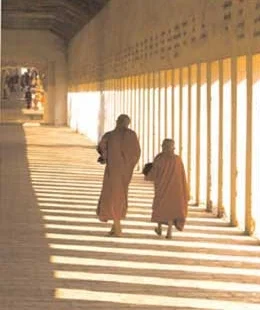
Book Review: Golden Earth
For many of its practitioners, travel writing is entirely a romantic venture by which the writer imagines himself as the hero of his own account, tramping his way through uncharted sands like Lawrence of Arabia. A more modest writer might see things less conceitedly and make himself the fool instead; but surely only a truly self-effacing one could resist the temptation of making himself the central character in his own travel book . . .
For many of its practitioners, travel writing is entirely a romantic venture by which the writer imagines himself as the hero of his own account, tramping his way through uncharted sands like Lawrence of Arabia. A more modest writer might see things less conceitedly and make himself the fool instead; but surely only a truly self-effacing one could resist the temptation of making himself the central character in his own travel book.
One such writer was the late Norman Lewis, a prolific traveller whose ego rarely made an appearance in any of his works. He once described himself as a semi-invisible man, a writer of “revealing little descriptions” who, in words that were always well considered, got to the heart of a place by examining its history and its people. In particular, he was interested in the indigenous people he met in the many countries he visited, those whose entire existence was—and in many cases still is—threatened by our ever-changing world.
Lewis had an exceptional gift for capturing the atmosphere of a country on the cusp of social or political change. In A Dragon Apparent (1951), about his travels in what was known then as Indo-China, he writes of Vietnam during a period of violent transition; and in Golden Earth (1952) details a war-stricken Burma that is already starting to develop in a most severe and baleful way. These books would likely have been considered classics even if Burma and Vietnam had changed little in the years following their publication. But it is true that they are made all the more interesting in light of the Vietnam War and Burma’s military junta.
Golden Earth is the lesser known of the two: surprisingly little appears to have been written about it online, as manifestly brilliant as it is. It opens memorably on a surge of description, with “Burma spread as a dark stain into the midnight sea,” and a “moonlight too weak” to reveal fully a breath-taking spectacle of golden pagodas. Yet by the very next page Lewis has shifted moods entirely, and is now explaining how, through “a slow process of compression and corruption”, officials handling his travel documents have managed to confuse his name with Thirty Bedford Square, the address of his publisher. Thus for the rest of his trip he is known as “Monsieur Thirsty Bedford”.
Lewis had a sense of humour like no other travel writer. His works were often funny, though rarely did he crack wise. His wit instead came from his remarkable ability to deconstruct the absurd using his typically dry, detached style. At his funniest, his prose read like that of S.J. Perelman, a writer Lewis admired and later befriended. But unlike Perelman, Lewis was never intent on merely making his reader laugh. In fact, often the most humorous parts of his books were also the most revealing. A perfect example of this can be found in the first half of Golden Earth, where Lewis describes his ordeal of eating a meal by which “all European prejudices about food had to be abandoned”.
Lewis dines in what he calls “a murky grotto” in which a cook stands, naked to the waist, with “a snippet” of intestine dangling from his finger. A lesser writer might have had his fun with this image and moved on, but here Lewis takes the opportunity to make fun of himself too, and later, after conceding to try the dish, is impressed to find that it is surprisingly edible. This is typically open-minded of Lewis, who never let a bad experience tarnish his image of a country or its people. A few pages later, he is trying to sleep and is startled by something he “half-dreamed half-thought” climbing up the leg of his camp bed. He soon discovers that he is sharing the bed with a scorpion, but again, resists the urge to grouse.
Of course, the reader understands why Lewis is reluctant to complain: compared to the people that Lewis writes about, his grievances seem inconsequential. Within the very first few pages of Golden Earth we hear how pirates have held up a ferryboat and killed three members of the crew, and similar incidents have become almost a daily occurrence. The Burma portrayed throughout the book is one of fear and unrest, where insurgents and warlords are commonplace, and the country’s post-colonial government can do little to stop them. Yet aside from this, Lewis is overwhelmed equally by the country’s breath-taking natural beauty and the kind generosity of the Burmese.
Their standard of living has been better in the past—this is a practically undisputed fact—but Lewis wants to know specifically if things were better in the days of British rule. Apparently it is commonly agreed: “Better?” they say. “Why even bring it up? Everyone was well off then.” British rule, we’re told, brought several enduring changes to Burma that completely transformed its once-agrarian society. Up until that point, kings had ruled the country, perhaps the most infamous of which being King Mindon Min. He is remembered largely for his attempts to modernise his kingdom, for his sheer brutality, and for his great many children, of which seventy were of royal birth.
Hsinbyumashin, one of his queens, dominated the last days of Mindon’s rule, and ordered that almost all possible heirs to the throne be killed, so that her daughter Supayalat and son-in-law Thibaw would become queen and king. What ensued was a long and brutal ceremony in which the siblings were placed in red velvet sacks and respectfully beaten to death in a festival lasting six days. “Clearing” is the word Lewis uses to describe the massacre, “cleared” being the current Burmese euphemism for such planned killings. As for the sacks—no doubt the reader has already guessed why these were made of red velvet: it was to “camouflage any unseemly effusion of royal blood”.
A great admirer of Herodotus, Lewis was a historian at heart, though he was also too gifted in other ways to be confined to that title. His accounts, as bold and brimming with description as they were, rarely took the form of step-by-step reportage. When Lewis did adopt the familiar style of most travel writers, he did so only briefly, and never to give the reader a greater impression of himself. The place and its people were always his priority; he was only ever a casual observer, a chronicler of the exotic, whose job it was to inform and entertain the reader, never to impose his personality upon them.
By revealing so little about himself, Lewis was able to say more about his subject and fill his accounts with more “revealing little descriptions”. Golden Earth paints a fascinating portrait of Burma at a notably turbulent time, and yet Lewis doesn’t stop there. As he reels through a substantial portion of its history, he also attempts to offer the reader an idea of how the average Burmese behaves and thinks. We are told that they are not a resentful people; they are, as a whole, accepting of Westerners, and their hospitality is sometimes so great that it borders on embarrassing. Lewis is treated like an old friend wherever he goes and with whomever he speaks, and frequently feels bad for taking so much in exchange for so little.
We learn, too, (though Lewis himself has his doubts) how the women of Burma enjoy “absolute equality” to men, and that long extracts from the ancient Laws of Manu can be quoted in support of this contention. Buddhism is the country’s main religion, and at first the Burmese can seem rather pious. But as Lewis explains, 1950s Burma is more modern than it at first seems. It is surprisingly British in some respects too, and Lewis does not find it especially strange when he encounters a man enjoying a Penguin D.H. Lawrence, or a Director of Prisons who quotes Chaucer. He is, however, amused to meet a restaurant owner who is eager to serve him egg and chips, despite Lewis’s insistence that he’d much rather try something more exotic.
Lewis seems genuinely beguiled by Burma. Looking beyond the fighting and unrest, he gathers a sense of what it is truly about, and fancies it a land where “the condition of the soul replaces that of the stock market as a topic of polite conversation”. Burma’s obvious political problems aside, he believes that it is a most exceptional country, better in many ways to our own: it is fertile, reasonably populated, and free from the damaging myths of colour, race or caste. “All that is necessary,” he concludes, “is to cure the people of their infantile craving for trash from overseas,” for unnecessary consumption has no place in Burmese life.
As for Burma’s communist incursions: Lewis predicts an incurable dictatorship that will lead to civil war. But never in the pages of Golden Earth does Lewis sound terribly pessimistic. He was an optimist in many ways, and this quality is the golden thread that can be found in all of his travel books. While he may have been interested highlighting man’s darkest propensities, he seemed to believe equally that man has the ability to do good. Otherwise he wouldn’t have written so fondly of the great many countries he visited. Lewis certainly saw plenty of good in the Burmese he met, and this mesmerising account is teeming with the same exuberance and compassion that he claimed to have witnessed on this unforgettable trip.
By Jack Sharp. Reproduced from nosoapradiopolka.co.uk
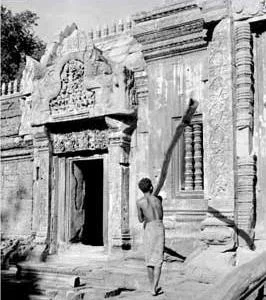
The Neglected Books Page: A Dragon Apparent
There were seven jars attached to the framework in the centre of the room and as soon as the chief’s sons-in-law had arrived and hung up their cross-bows on the beam over the adventures of Dick Tracy, they were sent off with bamboo containers to the nearest ditch for water . . .
There were seven jars attached to the framework in the centre of the room and as soon as the chief’s sons-in-law had arrived and hung up their cross-bows on the beam over the adventures of Dick Tracy, they were sent off with bamboo containers to the nearest ditch for water. In the meanwhile the seals of mud were removed from the necks of the jars and rice-straw and leaves were forced down inside them over the fermented rice-mash to prevent solid particles from rising when the water was added. The thing began to look serious and Ribo asked the chief, through his interpreter, for the very minimum ceremony to be performed as we had other villages to visit that day. The chief said that he had already understood that, and that was why only seven jars had been provided. It was such a poor affair that he hardly liked to have the gongs beaten to invite the household god’s presence. He hoped that by way of compensation he would be given sufficient notce of a visit next time to enable him to arrange a reception on a proper scale. He would guarantee to lay us all out for twenty-four hours.
This being the first of what I was told would be an endless succession of such encounters in the Moï country I was careful to study the details of the ceremony. Although these varied in detail from village to village, the essentials remained the same. The gong-orchestra starts up a deafening rhythm. You seat yourself on a stool before the principal jar, in the centre, take the bamboo tube in your mouth and do your best to consume the correct measure of three cow-horn’s full of spirit. Your attendant, who squats, facing you, on the other side of the jar, has no difficulty in keeping a check on the amount drunk, since the level is never allowed to drop below the top of the jar, water being constantly added from a small hole in the side of the horn, on which he keeps his thumb until the drinking begins. After you have finished with the principal jar, you more to the right of the line and work your way down. There is no obligatory minimum consumption from the secondary jars. At frequent intervals you suck up the spirit to the mouth of the tube and then, your thumb held over the end, you present it to one of the dignitaries present, who, beaming his thanks, takes a short suck and hands it back to you. In performing these courtesies you are warned to give priority to those whose loin-cloths are the most splendid, but if, in this case, the apparel oft proclaims the man, age is a more certain criterion with the women.
The M’nongs are matriarchal and it is to the relatively aged and powerful mothers-in-law that all property really belongs. Although the women hold back for a while and it is left to the men to initiate the ceremonies, the rice alcohol, the jars, the gongs, the drums and the house itself are all theirs. It is therefore, not only a mark of exquisite courtesy but a tactful recognition of the economic realities to gesture as soon as possible with one’s tube in the direction of the most elderly of the ladies standing on the threshold of the commonroom. Wth surprising alacrity the next stool is vacated by its occupying notable to allow the true power in the house with a gracious and impeccably toothless smile to take her place. This toothlessness, of course, has no relation to the lady’s great age and arises from the fact that the incisors are regarded by the Moïs as unbearably canine in their effect and are, therefore, broken out of the jaws at the age of puberty.
Reproduced from The Nelgected Books Page: Where Forgotten Books are Remembered
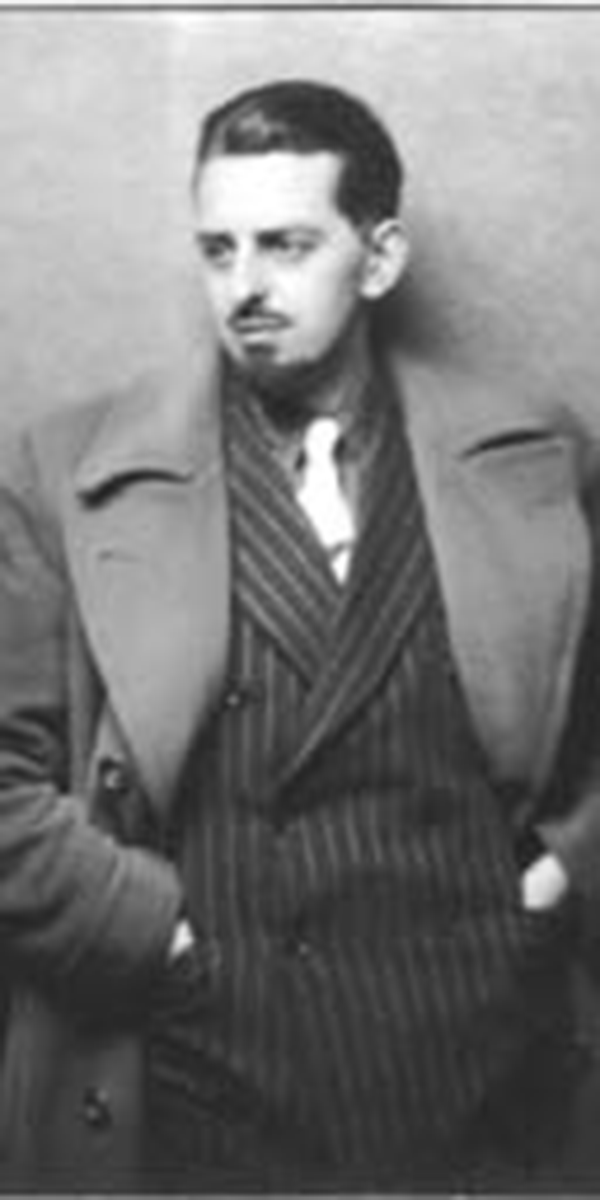
Obituary by Julian Evans for The Guardian, July 2003
The writer Norman Lewis, who has died aged 95, once claimed to be the only person he knew who could walk into a room full of people, and leave it some time afterwards without anyone else realising that he had been there. That there was only limited truth in the assertion was unimportant; it says far more about his modesty that failing to attract attention was the only claim he pretended to . . .
Deeply private writer whose civilised prose bore witness to the world's atrocities and follies
The writer Norman Lewis, who has died aged 95, once claimed to be the only person he knew who could walk into a room full of people, and leave it some time afterwards without anyone else realising that he had been there. That there was only limited truth in the assertion was unimportant; it says far more about his modesty that failing to attract attention was the only claim he pretended to.
Ever since he started on the extraordinary sequence of books announced by A Dragon Apparent in 1951, about his travels in French Indochina, the truth about Lewis's discreet personality was something he left others to decide; rarely did his ego make more than fleeting personal appearances in his work - not even in Naples '44 (1978), his hauntingly comic memoir of the second world war, or his two volumes of autobiography, Jackdaw Cake (1985) and The World, The World (1996).
With mandarin-like courtesy, he once stated that he preferred to produce "revealing little descriptions; I think of myself as the semi-invisible man".
When a writer is as highly praised over his lifetime - and by as many respected voices - as Lewis was, one may feel a residual meanness that the object of admiration might have been admired too long, finishing up being praised for being praised. Luigi Barzini described reading his prose as "like eating cherries".
Reviewers eager for a lazy comparison mentioned him in the same breath as Graham Greene; and Greene himself had "no hesitation in calling him one of the best writers, not of any particular decade, but of our century". And to re-read any of Lewis's accounts of travel - to Indo- china and India, to Burma, Latin America, Spain, Sicily or Indonesia - is to fall instantly under the spell of his subtle, refulgent musical magic.
By the second page of A Dragon Apparent, one already knows that his reputation as a stylist is safe: "On the morning of the fourth day the dawn light daubed our faces as we came down the skies of Cochin-China . . . With engines throttled back, the plane dropped from sur-alpine heights in a tremorless glide, settling in the new, morning air of the plains like a dragonfly on the surface of a calm lake."
One of his fellow passengers is a Foreign Legion colonel, who notices the cloud of an explosion from "une opération": "Authority flowed back into the travel-weary figure. With the accession of this priestly essence he dominated the rest of the passengers. Beneath our eyes violence was being done, but we were as detached from it almost as from history. Space, like time, anaesthetises the imagination. One could understand what an aid to untroubled killing the bombing plane must be."
The value of Lewis's writing lies not only in that civilised style that, as Cyril Connolly said, could make a lorry interesting. Literary style is a Peter Pan - marvellous and then tiresome for not growing up - but in Lewis's delight in describing the surfaces of the world lay the most elegant of warnings.
In his mid-80s, in his conservatory at home in Essex, he summarised the order of his interests as "travelling, writing and growing lilies"; he travelled before he turned writer, beginning in the relatively incorruptible Spain of the early 1930s, and going on for more than 60 years to observe the ebb and flow of governments, the dissolution of indigenous tribal cultures and the activities of missionaries, bandits, profiteers and political scene-shifters.
He was among the first to witness the idiocy of an American foreign policy that thrust countries into the embrace of communism. In A Dragon Apparent, he foresaw the ultra-efficiency of the bombing plane 15 years before the long-houses of the Moïs people of Vietnam's central plateau were bombed into nothingness, and in Golden Earth (1952) he predicted the incurable dictatorship that would be the consequence of Burma's approaching civil war.
In 1968, observation hardened into involvement when, travelling to Brazil for the Sunday Times with the photographer Don McCullin, he saw the results of atrocities committed against the natives by the government's own Indian protection service. The long report he wrote on his return caused an international outcry, and led to the establishment of Survival International.
Lewis once said that he had no doubt that a slightly evangelical attitude hung over his books. To his readers, this was more of his modesty, even disingenuousness. Gregarious writers tend not to want to make the world stand at moral attention, and Lewis's work was always rescued from high-mindedness by his preference for communicating his enjoyment.
His dozen novels - among them The Day Of The Fox (1955), The Volcanoes Above Us (1957), A Small World Made To Order (1964), and The Sicilian Specialist (1975), which had the distinction of becoming a cold-war bestseller in both the US and the Soviet Union - were darker than his non-fiction. But they explored the same richly unexpected world: the Saigon waterfront where one chose a soft drink more for its auspicious colouring than its taste; Pnom Penh, where, taking a taxi, he was offered a tip by the Buddhist driver; the Burmese policeman whose courtesy made it impossible for him to decide whether he was under arrest.
Where another writer might have dished out such experiences with a moralising linctus or a fake spirit of adventure, Lewis gave them to us page after page, year after year, as the most delicious of unaging wines.
Born in Enfield, north London, as a clever child he was a target for the casual cruelty of other children. His parents sent him to live for a couple of years with three half-mad aunts in Wales, who crammed the Bible down his throat. This was "not a bad experience", he asserted, as it drove his desire to escape once he had left Enfield grammar school.
By his mid-20s, he was interested in nothing but travelling and writing. He published two books before the second world war, Spanish Adventure (1935, later disowned) and Sand And Sea In Arabia (1938); he wryly referred to one reviewer's description of the latter as "Biblical but soporific".
Three years in the Intelligence Corps in north Africa and Italy, from 1942 to 1945, completed Lewis's rupture with his suburban past - and with Ernestina, his Swiss-Sicilian wife and the mother of his first child. After the war, he continued a relationship he had begun with Hester, who had nursed him in Naples, divorced Ernestina, and had two more children. In 1953, he met his second wife, Lesley, an Australian working for an airline; she and their two daughters and son survive him.
Using the experience gained as an ex-son-in-law of Sicilian exiles and in military intelligence, Lewis wrote his unsurpassed portrait of the Mafia conspiracy, The Honoured Society (1964). Through his friendship with the American humourist SJ Perelman, he was introduced to William Shawn, the reclusive editor of the New Yorker, which serialised the book in its entirety.
A childhood spent dodging bullies and his aunts may have been the basis of his later invisibility; whatever the reason, his gift for observing unnoticed - whether it was Panare Indians under the missionary gun in The Missionaries (1988), the wartime Neapolitan demi-monde in Naples '44, or the fishermen of Spain's vanished shores in Voices Of The Old Sea (1984) - was one of the capital secrets of his writing.
Wherever he went, his concern to uncover the human comedy (and calamity) was the same. Only two places defeated him. One, unsurprisingly, was California; on another occasion, when a Sunday paper invited him to name a place he had never been to, he said frivolously, "Tahiti", believing that the editor would never contemplate the air fare. The next thing he knew he was on a plane for Papeete. The piece appeared, as much like a bowl of cherries as ever, but in private Lewis said the trip had been "extraordinarily boring. There was absolutely nothing to do there. I wish I hadn't gone."
In his last decade, he published a string of books that would have been prolific for a writer half his age: An Empire Of The East (1993), about his travels through Indonesia; The World, The World; a collection of articles, The Happy Ant-heap (1998); and In Sicily (2000), about his return to that haunted island. He had also had it in mind for some time to revisit the Spain of his first, 1934 adventures. The Tomb In Seville, to be published in November, is the result.
Meeting Norman Lewis, one was struck by his tremendous politeness; by his melodic, rasping voice that somehow commanded attention, somewhere between a suburban drill sergeant's and a naturalist's, stalking a timorous bird; by his great liking for almost any red wine; and by his shyness. Once he had decided you could be trusted, however, he appeared to have nothing to hide: stories and confidences poured from him with a reckless candour.
But the biography was not quite so simple. The ascetic writer and witness came after the young rake and dandy, with his love of fast cars and adventure. This period of his life he rarely talked about. His taste for happiness - what he called "the intense joy I derive from being alive" - was not blithe, but his deliberate weapon against rejection, boredom, stupidity and routine. His second wife remarked that he got horribly bored on family holidays because he was unable to make things up.
Literary judgments are often at odds with human judgments. Possibly due to his shyness, Lewis never crossed what the critic JW Lambert called "the mysterious barrier separating the admired from the famous". But his magnificent, exact rendering of the world, in his mordant, civilised and generous prose, has no comparison.
He suffered slightly from being boxed-off as a writers' writer. The condescension is inaccurate: writing so close to the surface of things, so close to the nerves underneath, he was merely himself. The few personal accomplishments that could be teased from him testified to his pleasure in that self: he raced Bugattis at Brooklands before the war. An omnibus edition of his novels in Russian translation outsold Tolstoy. And his lilies were some of the rarest in England.
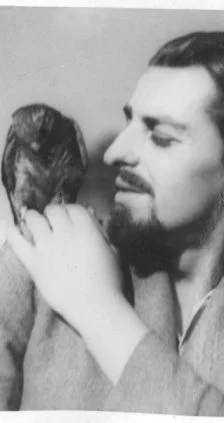
The spy who liked to stay out in the cold
This is a biography by someone who dislikes biography about someone who disliked exposure,' declares Julian Evans in his preface, adding that he wrote this book only to stop anyone else doing so . . .
This is a biography by someone who dislikes biography about someone who disliked exposure,' declares Julian Evans in his preface, adding that he wrote this book only to stop anyone else doing so. From such an unpromising start, he has nonetheless written an excellent literary biography about one of the truly outstanding writers of our time — a man described frequently as a travel writer but who defies categorisation. Norman Lewis's 14 novels have been likened to those by Graham Greene and his non-fiction shows him to have been a great reporter and a contemporary historian.
Evans was Lewis's friend and publisher, and he has diligently gathered a wealth of material from family papers and interviews with Lewis's childhood sweetheart, his third wife, his six children and many others.
Born in 1908, Lewis was clever, though badly bullied at school. At one point, he was sent away to live with his Welsh aunts, an episode he describes vividly in his memoir, Jackdaw Cake.
His parents were eccentric almost to the doors of the asylum. After losing three of her four young sons, his mother turned to spiritualism. His father — a gloomy Welsh alcoholic — considered their home in Enfield, Middlesex, a foreign country.
Gwen Nicholls, who grew up with Norman Lewis and who stoutly resisted his persistent attempts on her virtue, remembers 'the Arab of Enfield', a 14-year-old boy who was determined to set himself apart.
Lewis was outraged when Gwen decided to marry someone else and, though uninvited, he attended her wedding so that he could interrupt the service at the appropriate moment. Gwen admitted to finding this 'incredibly flattering'.
To teach Gwen a lesson, Lewis married Ernestina Corvaja, an enigmatic Sicilian beauty whose father, banished from Mussolini's Italy after committing a serious crime, became an admired figure in Norman's life for 'his implacable loyalty and sense of fatalistic irony'.
Lewis was attracted to the Corvaja family because of their openness of mind, and lack of religious belief, classconsciousness and national pride.
All this was contrasted strongly with Enfield and an England that was beginning to give him asthma. Lewis started out as a small businessman with a specialist camera shop in Holborn, central London.
The business did well and he raced his own Bugattis — but he was bored and he started to travel with Ernestina. Once he stepped abroad, the asthma disappeared.
The embarrassment of Norman Lewis's childhood shaped a personality that was extremely wary. He once said that he was the only person he knew who could enter a room, sum up the situation and leave it without anyone knowing he had been there — a helpful attribute for someone who worked as a part-time British spy.
In the modern world of literary festivals and me-and-myfamous-life promotions, Lewis would have been a publisher's nightmare. In fact, he was pretty much a publisher's nightmare anyway, twice abandoning his career as a novelist, refusing to be categorised as a travel writer and capable of passing an entire business lunch in silence.
There was nothing to be done with Norman except publish him — and insist on the exceptional quality of his work.
Despite early critical acclaim, this was not the way forward and in the Seventies Lewis said he had given up going into bookshops because he became so depressed when he saw that his titles were never in stock.
He turned to journalism and wrote a famous article in The Sunday Times Magazine about the genocide of the Brazilian Indians. This piece led to the creation of Survival International.
Working with Colin Jones and Don McCullin, he contributed a celebrated series of foreign reports from around the world, frequently battling American foreign policy.
Evans includes a wonderful account of a farcical trip Norman made to Peru in search of the Senderosa Luminosa guerillas.
Unfortunately, McCullin had been replaced by Lord Snowdon, who tried to treat Norman as his valet, while insisting on 'No publicity'.
Norman said it was the worst trip he had ever made and opened his account of his misadventures by asking: ' Have you ever heard of a man called Lord Snowdon?' During 1982, Lewis was reinvented by the energetic young publisher John Hatt who reprinted A Dragon Apparent, Lewis's account of Indo-China during France's war with the Viet Minh.
Hatt followed this with four other titles, including Naples '44 — which American writer Martha Gellhorn chose as her best travel book of all time. Lewis had gathered the material in his wartime capacity as a field intelligence officer. Much of the information came from the office wastepaper basket.
Semi-Invisible Man is a sensitive and perceptive record of a very difficult subject and deserves every success. Evans deals with Lewis's three marriages fairly, and is scrupulous about confessing when he has no information.
Many of Lewis's titles are back in print, but two of the best of his early novels, The Day Of The Fox and The Volcanoes Above Us, currently await a publisher.
Norman Lewis died in 2003 aged 94, cared for by his third wife, Lesley. Shortly before he 'made himself scarce' for the last time, he called out for 'Monty' — the beloved older brother he had lost when he just seven.
The Life of Norman Lewis, Julian Evans, Daily Mail

Desert Island Discs
Norman Lewis has spent a lifetime travelling the world and writing about it. In conversation with Michael Parkinson, he recalls his curious upbringing in Wales with three maiden aunts, his travels in Cuba where he met Ernest Hemingway, and his love of Naples which led to his writing two books on the Mafia. He also chooses the eight records he would take to the mythical island . . .
Norman Lewis has spent a lifetime travelling the world and writing about it. In conversation with Michael Parkinson, he recalls his curious upbringing in Wales with three maiden aunts, his travels in Cuba where he met Ernest Hemingway, and his love of Naples which led to his writing two books on the Mafia. He also chooses the eight records he would take to the mythical island.
LISTEN HERE
[Taken from the original programme material for this archive edition of Desert Island Discs]
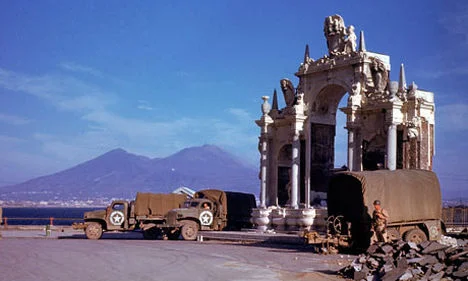
'Iniezione Reconstituenti' - From Naples '44
Neapolitans take their sex lives very seriously indeed. A woman called Lola, whom I met at the dinner-party given by Signora Gentile, arrived at HQ with some denunciation which went into the waste-paper basket as soon as her back was turned. She then asked if I could help her. It turned out she had taken a lover who is a captain in the RASC, but as he speaks no single word of Italian, communication can only be carried on by signs, and this gives rise to misunderstanding . . .
Neapolitans take their sex lives very seriously indeed. A woman called Lola, whom I met at the dinner-party given by Signora Gentile, arrived at HQ with some denunciation which went into the waste-paper basket as soon as her back was turned. She then asked if I could help her. It turned out she had taken a lover who is a captain in the RASC, but as he speaks no single word of Italian, communication can only be carried on by signs, and this gives rise to misunderstanding. Would I agree to interpret for them and settle certain basic matters? Captain Frazer turned out to be a tall and handsome man some years Lola’s junior. Having his hands on military supplies, he could keep her happy with unlimited quantities of white bread, which for Neapolitans in general - who have been deprived of decent bread for two years - has come to symbolize all the luxury and abundance of peace. She was also much impressed by his appearance. The Captain was a striking figure. His greatcoat had been specially made for him and it was the most handsome coat I had ever seen. His hat was pushed up in front and straightened with some kind of stiffener. This, although Frazer worked at a desk, made him look like an officer in a crack German SS formation. She wanted to know all about his marital status and he hers, and they lied to each other to their hearts’ content while I kept a straight face and interpreted.
She asked me to mention to him in as tactful a way as possible that comment had been caused among her neighbours because he never called on her during the day. Conjugal visits at midday are de rigeur in Naples. This I explained, and Frazer promised to do better.
When the meeting was over we went off for a drink, and he confided to me that something was worrying him too. On inspecting her buttocks he had found them covered with hundreds of pinpoint marks, some clearly very small scars. What could they be? I put his mind at rest. These were the marks left by iniezione reconstituenti: injections which are given in many pharmacies of Naples and which many middle-class women receive daily to keep their sexual powers at their peak. Frequently the needle is not too clean, hence the scars.
She had made him understand by gestures one could only shudderingly imagine that her late husband - although half-starved, and even when in the early stages of tuberculosis from which he died - never failed to have intercourse with her less than six times a night. She also had a habit, which terrified Frazer, of keeping an eye on the bedside clock while he performed. I recommended him to drink - as the locals did - marsala with the yolks of eggs stirred into it, and to wear a medal of San Rocco, patron of coitus reservatus, which could be had in any religious-supplies shop.

Biography by Julian Evans
Norman Lewis’s life was as significant in historical terms as it was colourful. As a witness to his times – the good, the bad and the absurd – he was unmatched; his instinct for important events was practically infallible. Among 20th-century writers, only Norman can tell you first-hand about being on the receiving end of the Asturian miners’ gunfire that preceded the Spanish Civil War and about the resistance of the East Timorese to President Suharto’s soldiers sixty years later . . .
Norman Lewis’s life was as significant in historical terms as it was colourful. As a witness to his times – the good, the bad and the absurd – he was unmatched; his instinct for important events was practically infallible. Among 20th-century writers, only Norman can tell you first-hand about being on the receiving end of the Asturian miners’ gunfire that preceded the Spanish Civil War and about the resistance of the East Timorese to President Suharto’s soldiers sixty years later.
Only Norman can tell you about visiting the ghost town of Suakin, Africa’s Venice and centre of the East African slave trade, in the 1930s; about the ancient Costa Brava of fishing villages before the tourist hotels were flung up; about meeting Hemingway in Cuba in 1959, when the world’s most famous author appeared in pyjamas, gulping half-pint tumblers of Dubonnet (“a shattering experience”, as Norman wrote to Ian Fleming, “of the kind likely to sabotage ambition”); and about an attempt on the Guatemalan president’s life in 1996, when the would-be assassin, gunned down by valiant presidential bodyguards, turned out to be a drunken milkman.
Born the son of a pharmacist in Forty Hill, on the desert edge of north London, in 1908, he was a precociously intelligent boy. Marked down as a social outsider by his schoolmates, who came from working-class or farm-labouring families, his cleverness doomed him. One day the headmaster at his elementary school said to the school inspector, in front of his class, “Of course we have a boy here who we don’t teach at all, he teaches himself.”
The headmaster’s compliment had an immediate and brutal impact. A campaign of bullying began, Norman remembered later, “of such an intensive kind that it would have been the headlines in the papers today. I remember being thrown in deep beds of nettles – that would have been in summer – and in winter I was thrashed with the sharp edges of sheets of ice. They were exceedingly cruel.”
He found refuge from bullying by being sent to Wales, where he was tipped from a theatre of cruelty into a theatre of the absurd. For a year he endured living with an autocratic, philandering grandfather and three mad aunts in Carmarthen; but it was the first of a lifetime’s escapes. When he came back, he set about turning the tables on Forty Hill. Employed in his father’s pharmacy in neighbouring Enfield, he sub-contracted his boredom by paying an assistant to hold the fort while he sat in the back of the shop reading Russian and other classics, the only novels available at Enfield’s Carnegie library. His writing is rooted in that very early reading: to read Norman is to fall under a spell of a refulgent, musical magic of prose, whose source is embedded in his youthful consumption of the King James Bible, Herodotus, Suetonius, Chekhov, Turgenev, Tolstoy and Dostoyevsky.
As I never had the chance to read rubbish,” he said, “I couldn’t absorb the rubbish which went with the style of the popular writers.”
Norman had three brothers, but of his parents’ four sons he was the only one to reach adulthood. The sequence of losses turned Norman’s parents to drink and spiritualism, and Norman felt the loss of his brother Monty (he was 7 when Monty died at 17, of kidney disease) especially deeply. His pleasure as a small boy in his father Richard’s company, walking and birdwatching where city and suburbs gave way to woods and orchards and countryside, was a short-lived idyll. When spiritualism and its séances and charlatans took over, and his parents put up a spiritualist chapel in their back garden to be able to contact the astral bodies of their dead sons, the idyll turned to deep embarrassment.
The cultural desert of Forty Hill and Enfield added to Norman’s sense of extreme alienation. It also played a curious part in his development as a writer.
Turn-of-the-century Enfield was divided: half the men cycled to work at the Enfield arms factory, the other half worked for the local landowners and had a slightly better life. Both were brutalised. For a boy of Norman’s intelligence, born into a socially aspiring family ruled by his father’s fits of depression and his mother’s passionate religiosity, it was a placed that instilled a desire for flight and disappearance, a situation he hinted at in one of his volumes of autobiography, writing that as a child he would go exploring “with the idea in my head that the farther I was from home the better it would be”.
The boredom of the Enfield milieu reinforced a determination to be elsewhere. He later described his adolescence as “an endless, low-quality dream... nothing, with chips”. So a direct link exists between a childhood spent among that combination of cultural cruelty, social pretension and daily tedium, and an adulthood spent seeking out and communicating the most intense, authentic and colourful experiences.
Yet for all Norman’s complaints about the horror and tedium of Forty Hill life, it offered him a hinterland, physical and sociological, that he could explore freely, and in the exploration fashion an outline for his later passions: obsessive escape, the glorious surfaces of the natural world, and the politics of rich and underdog.
In his twenties Norman became enthusiastic about cars, bought and raced Bugattis at Brooklands, married Ernestina, the daughter of a mafia lawyer exiled in London, and discovered a knack for making money. He went through a prolonged period of discovery. His sense of adventure gradually sharpened and enlarged, and his conviction of Enfield’s ghastliness never softened, but until he was 26 his base remained there (he even returned regularly to stand behind the counter of his father’s shop).
The dream that the next valley would always be wilder was not driving him yet; the decade that followed his adolescence was an experimental phase, during which he still breathed mostly suburban air. He might have been mystified as to how exactly to make a break: he was self-invented, had no mentors, no path of middle-class privilege to follow, no Oxford or Cambridge or country-house upbringing to ease his way: unlike almost every writer – Robert Byron, Wilfred Thesiger, Patrick Leigh Fermor, Peter Fleming, Eric Newby – who would become his contemporary.
His energy for a long time went into making money as the key to escape. He plagiarised German newspapers for stories he sold on to English magazines, and with the help of his mafia-connected father-in-law established a chain of camera shops, from which he financed his first journeys, to Spain in 1934 and Arabia in 1937.
Yet, astonishingly, both those journeys resulted in a book, both of which he succeeded in getting published: Spanish Adventure by Gollancz, and Sand and Sea in Arabia by Routledge. He later disowned the first as a “devastating piece of juvenilia” and referred wryly to one reviewer’s description of the second as “Biblical but soporific”.
His marriage to the manic, competitive Ernestina did not last. He was in Cuba with her and their son Ito when Britain declared war. He made the complicated arrangements to return home with enthusiasm, with war offering him the perfect excuse to abandon her with dignity. She and Ito would be safer there, staying with friends, than in England. In New York someone took his photograph, standing on a gangway in front of the ship he was about to sail on, the SS President Harding. He is leaning against the rail, a smile of cheerful good fortune on his face. Europe’s conflict was already being good to him.
And his sense of luck persisted, all through the hostilities.
“The war was something fantastic. I hate cruelty of any kind, I am a passionate person, but every minute of the war, all the time I was abroad, [was] absolutely paradise.”
Those were his words more than 50 years later. The intense pleasure of his war years became the banner and device of his post-war adventures, the reality that he was always seeking to recreate, and in the postwar peace of 1945, all his problems, literary and personal, would start to reduce to one problem, how to retain the happiness of war.
Three years as an NCO in Field Security, a branch of the Intelligence Corps, in north Africa, Naples and Austria, completed the rupture with his suburban past. Freedom somehow brushed him with its wing, even in the middle of conflict.
“Nobody really quite understood what we were doing”, one Field Security section member remembered, “we enjoyed a certain mystique, and even senior officers were chary of challenging our activities.”
The best known part of Norman’s wartime service (described in his memoir Naples ’44), is the year he spent in that devastated and occupied city. The year was actually 18 months, and to Norman the city seemed less a great theatre than a great actor, a living, breathing performer whose joys – its absolute democracy, its unexpectedness, its earthy pleasures, human intensity and emotional unity – would bring him back to write about it again and again after the war was over.
His Naples experiences were not all joy. Many episodes stand out in Naples ’44; but one, both in his notebooks and the published version, is still indelible to me among the vital, shabby chaos of the city. Norman describes sitting in an unheated restaurant near piazza Victoria with his contact Vincente Lattarullo, and seeing six war-orphaned girls “between the ages of nine and twelve” appearing in the doorway. They wore hideous black institutional dresses, and were crying. As they groped their way between the tables, he saw that they were blind.
“I expected the indifferent diners”, he wrote, “to push back their plates, to get up and hold out their arms, but nobody moved. Forkfuls of food were thrust into open mouths, the rattle of conversation continued, nobody saw the tears…. Until now I had clung to the comforting belief that human beings eventually come to terms with pain and sorrow. Now I understood I was wrong, and like Paul I suffered a conversion – but to pessimism. These little girls, any one of whom could be my daughter, came into the restaurant weeping, and they were weeping when they were led away. I knew that, condemned to everlasting darkness, hunger and loss, they would weep on incessantly. They would never recover from their pain, and I would never recover from the memory of it.”
Norman had a more complete relationship with Naples than anywhere else he had lived. He wrote later, “The income per capita is only a third of that in Milan; but, for me, Naples will always be the better place to live in.”
His enforced stay in the city also fostered a restlessness that he channelled into the discipline of writing, which, he said, compelled him “to see more, to penetrate more deeply”. Vital for his development as a stylist, with the demands it imposed to render tragedy and absurdity often simultaneously, Naples confirmed him as the kind of writer he would become.
His first postwar travel book, A Dragon Apparent (1951), the account of a journey through Vietnam, Laos and Cambodia, established his reputation. For the next decade and a half he undertook a series of peregrinations through Burma, Spain, Italy, central America, Siam, India and Ceylon, equatorial Africa, and the less travelled parts of south America, resulting in a series of accounts that included his account of Burma before the military took over, Golden Earth, and his ground-breaking history of the Sicilian mafia, The Honoured Society.
He published six novels and was judged to be, at his best, on a par with Graham Greene. He continued an affair he had begun with a nursing sister, Hester, who had nursed him at Philippeville when he crashed his Army motorbike in Algeria in 1943. He divorced Ernestina, started another family, and then, ever a complicated lover, separated from Hester. In 1953 he met Lesley Burley, a 23-year-old Australian working for British Airways – Norman was 45 – with whom he finally remained settled, more or less, and eventually married.
Unanimity of opinion is rare where critics are concerned, but from the early 1950s Norman’s writing attracted it. By the time he published A Dragon Apparent in 1951 he had shed his dandyish pleasure in language as a way of showing off, replacing it with prose that was an essay in understatement, allowing him to magnify events while seeming to do the opposite.
A Dragon Apparent was written in language that knew how to be subtle, direct and almost invisibly humorous – alive to the absurdities of life, its melancholy and its ironies. Peter Fleming called it “A brilliant report on a period of violent transition in a strange land… a very good book indeed.” The Economist felt it “should take its place in the permanent literature of the Far East”. Cyril Connolly summed up the reaction to a particular genius Norman had for making strings of ordinary English words turn into vivid objects when he wrote that “Mr Lewis can make even a lorry interesting”.
Norman travelled in a spirit of aesthetic curiosity, immersing himself as far as possible in the places and situations he found himself in. This was possible in part because of the knack he had acquired early in his life of making himself scarce.
As he put it, “I’m probably one of the few people that can actually enter a room and leave it, and nobody will know that I’ve been there. I can just come in completely silently, I can turn the handle of the door, I can let myself in, I can sum up the situation and retreat, and nobody will know that I’ve been there.”
Starting in the early 1950s he spent each summer at “Farol”, a village on Spain’s Costa Brava, in reality Tossa de Mar, and later, as Tossa inexorably fell to the alien invasion of tourists, on the island of Ibiza. He wrote nothing about his Spanish summers for more than 30 years. When he did, in Voices of the Old Sea, he offered elegy tinged with farce, tragedy rescued by revealing comic detail.
He himself, as he always was, was curiously absent from the narrative. This was another hallmark. He turned his early shyness into a prose virtue, and his presence in his works is always transfigured. He was, and is, a voice and a style, not an ego.
Another journey he made in the 1950s supplies a further clue to his reticence. In 1957, at the instigation of Ian Fleming, he met Ernest Hemingway at his finca outside Havana.
“There was something biblical about the meeting with Hemingway,” Lewis wrote to Fleming afterwards, “like having the old sermon on the vanities shoved down your throat.”
Lewis continued to suspect fame of Hemingway’s kind. In an interview in 1990 he elaborated briefly on this aspect of his career.
“I prefer to produce revealing little descriptions,” he said. “I think of myself as the semi-invisible man.”
The 1950s and 1960s were decades of plenty for Norman, the writer and the man. The self-effacing quality that had allowed him to observe unnoticed also hid an extraordinary glamour. He began spying, in a casual way, for the British government after meeting Ian Fleming at a party given by his publisher, Jonathan Cape. He lived in Orchard Street, opposite Selfridge’s in London’s West End. His flat was minimalist avant la lettre, apart from the bachelor’s bedroom, which had a deep pink ceiling and wall-width, heavy black and gold curtains, and he entertained lavishly there. He was a crack shot – parties at Orchard Street often included target practice – and flamboyant host; when things got slow, he took benzedrine to speed them up again. He led a life of such self-pleasing freedom that his existence at times was closer to a rock star’s than anyone else’s.
His writing was also taking him to the edges of experience. In the early 1960s he travelled to Palermo and, using his connections as a former son-in-law of mafia exiles and a sergeant in the Intelligence Corps, completed the research for his portrait of the mafia conspiracy, The Honoured Society. He became friends with S J Perelman, who introduced him to William Shawn, the reclusive editor of the New Yorker, which serialised the book in its entirety.
A divide came in his writing in 1968. Working for The Sunday Times, he travelled to Brazil and wrote about the genocide of the country’s Indians. He claimed that thereafter he ceased to be a perpetual spectator, that in the face of such calamity “it is not possible to keep silent”. The 12,000-word essay he wrote about Indian genocide led to the founding of Survival International, dedicated to the rights of indigenous peoples, and he frequently said afterwards that “Genocide” was the piece of writing he was most proud of.
The next year he returned to Mexico twice, to investigate the predicament of the Huichols of the Sierra Madre, attacked by mining companies. An ill-fated digression to Peru with Lord Snowdon followed, and in 1970 he made a more rewarding journey with another photographer, Don McCullin, to Guatemala. In 1975 he and McCullin, who had become close friends, travelled on another joint assignment to Paraguay and succeeded in proving allegations that missionaries had been involved in Indian hunts.
In 1978 Norman at last published the book based on his wartime diary of life in occupied Italy, Naples ’44, described by Eric Newby as “one of the ten best books about the war”. He was in the front rank of English writers, praised by V S Pritchett, Peter Fleming and Graham Greene as one of the best writers of the century; yet he had still not crossed what J W Lambert in The Sunday Times called “the mysterious barrier separating the admired from the famous”.
The comment was prophetic, because Norman’s reputation suffered a partial eclipse in the 1970s, his subjects too exotic for that wan decade. It recovered when John Hatt, founder and publisher at the small paperback house Eland Books, reprinted Naples ’44 in 1983 and secured 120 reviews of the book, every one acclaiming its author.
In the 1980s Norman’s work quietly lived through the travel-writing boom and then outlived it. In person, he remained as enthusiastic as before for the “glorious surfaces” of the world, although he noticed that change was increasingly rapid and irreversible. He revisited places he had seen before – Spain, Thailand, India – and published his memoir of vanished Spain, Voices of the Old Sea; a first volume of autobiography, Jackdaw Cake; an investigative polemic against The Missionaries; and two more novels.
Refusing to be judged on his age (in 1988 he celebrated his 80th birthday), he quietly lost a decade, supplying 1918 as his date of birth in his books’ cataloguing-in-publication data. To friends at his 80th birthday party at the Lewises’ Essex house, a parsonage in the village of Finchingfield, he seemed perpetually youthful, perpetually tough; so tough that in his ninth decade he travelled to the heartland of tribal India, and to Sumatra, the West Papuan highlands and East Timor for two more books; later returning to West Papua for a Channel 4 film.
On that occasion, finally, invincibility deserted him. He had to be helicoptered out of West Papua’s Baliem valley, suffering from pneumonia. Illness hardly broke his step, however, and when he recovered he went on travelling back to Spain, Sicily and Guatemala in the late 1990s for material for The World, The World, his third volume of autobiography; a collection of pieces; and a new book about Sicily.
In June 1998, Norman celebrated his 90th birthday at his daughter Samara’s house in Brighton. The following morning I walked with him, his wife Lesley and Samara to the seafront. It was a fresh English Sunday by the sea. He wore a sweater with his blue cotton trousers and jacket, and the long wisps on top of his head danced in the gusts of breeze. His expression was watchful, still, halfway between blankness and serenity, until he leaned over the rails at the edge of Marine Parade and suddenly became animated, pointing out the stretch of tarmac below. This was Madeira Drive, along which he had competed in a standing half-mile in his Le Mans-winning Alfa Romeo in 1938. “Coming second to last in my class,” he said cheerfully. At the age of 90 he still insisted that he had never won anything, never discovered anything, had no distinction; an inverted conceit that time had not changed.
He went on writing: a collection of pieces, The Happy Ant-Heap; a new book about Sicily, In Sicily; another collection, A Voyage By Dhow, in which he reached further back into the past; all books that were celebrated for extra-literary as well as literary reasons. His stories “ring with the restless melancholy of old age”, one reviewer wrote. “It is a pleasure to share the addiction of such a stylist as he once more feeds his habit,” another said. The Times offered him its best bouquet, commenting that “reading Lewis on Sicily is like reading a modern Homer or Pausanius”.
He continued willingly to submit to the discipline of work. “It is my salvation,” he confidedto a journalist who came to interview him. Even after the irrefutable signs of Alzheimer’s disease appeared when he was on holiday in the Midi-Pyrénées with his family in 2000 – he was 92 – he continued to write.
The result was The Tomb in Seville: a revisitation of his very first journey to Spain, just before the Spanish Civil War. It had been a key journey for his formation as a writer and observer; had lit the flame of his obsession with the world’s glorious surfaces. When he travelled there in September 1934, Spain was Europe’s antithesis and his own: a country of extremes, hallucinations and unquenchable vitality, an intense, symmetrical escape from Enfield’s nothingness.
His last book is a double reconstruction, of a journey and of a memory of a journey, into a double time, a twentieth century that precedes the twentieth century: Moorish Spain, pre-industrial Spain, Spain on the brink of Africa. It was a place and a time that, ever after that first journey, was more than a subject for Norman. It was a pole, a magnetic South, its flag planted in the city of Seville, to which he was drawn back repeatedly and by which he set the compass of all his subsequent escapes.
The Tomb in Seville took him longer than he expected. By the time he delivered the manuscript to his publisher in late 2002 he was 94, seriously affected by Alzheimer’s, losing weight and cognition. He had angina and a faulty heart valve, and his doctor thought he would not last beyond Christmas. He did, and went on clinging to the remnants of his toughness for a few months more; sometimes rebelling, not sleeping and staying up much of the night, eating chocolates and drinking red wine. But in July, a few days after his 95th birthday, he was admitted to a community hospital near Finchingfield, at Saffron Walden. In his last hours, unconscious, he called out for Monty, his beloved older brother whom he had not seen since he was seven. He died in hospital on 22 July 2003, with his wife Lesley at his side. He had made himself scarce for the last time.
. . .
Despite standing in the shadows and loathing publicity, despite never becoming famous, Norman’s contribution to English letters has been great: his quiet literary achievement is unlike any other, his influence resonant. As witness, observer, revolutionary stylist, he has taught many younger writers much of their craft by example, although none has achieved his degree of self-effacement. He has changed what it means to describe our world, to allow it, almost, to describe itself in sentences of magnificently sly understatement, sentences that understand the formal connection between the sad lyricism of experience and the revealing comic detail, sentences so true to life that their end is never to be guessed from their beginning.
And he has changed the eligibility of who can be a writer of his calibre. For the British, travel generally means escape; but up until the Second World War British travel writers often blatantly did two jobs at once. The high passes they negotiated, the deserts and rivers they conquered, might be a personal triumph today, an imperial army’s supply route tomorrow. The Royal Geographical Society boasted more colonels than a junta, and nearly without exception British travel writers were upper-class, landed, Oxford or Cambridge-educated, and the products of a leisured upbringing. Norman, on the other hand, escaped as a classless Everyman might, in a spirit of pure fascination, compelled by the pull of the world.
But the value of his writing is not just in his sensuous, understated style or the light-lashing wit that constantly accompanies it. Somewhere in his delight in, and appetite for, the world there has lain since the beginning the acutest of warnings.
He was one of the first to realise that American foreign policy was pushing southeast Asia into the embrace of Communism, and foresaw “what an aid to untroubled killing the bombing plane must be” 15 years before B52s bombed the Moï tribespeople of Vietnam’s central plateau into nothingness. He predicted Burma’s dictatorship, and in India the gulf that would appear when urban poverty replaced the more tolerable rural version that preceded it.
He recorded our own impoverishment by the twentieth century’s most cherished objectives – industrial prosperity, universal communications, mass tourism and globalisation – and woke us up to some of their severest consequences. As early as 1979 he was the first mainstream writer to predict that the Earth’s climate would change, after a journey to the Amazon basin.
Above all, he provided us with a context to a pleasure we are encouraged to indulge without thought – cheap, consumable global travel – while at the same time seeking out and communicating the qualities in life that stirred him most: passionate resistance, revolutionary determination, tribal loyalties, and unquenchable vitality.
He himself started travelling as a Romantic escapee and continued as a more worldly one, but he ended up in a sort of self-denying sub-category (he hated five-star hotels or almost any kind of luxury beyond good wine), pleasing himself merely in his observation, addicted equally to the words he found and the places they portrayed. He made it his pleasure to tell stories about places that still had stories.
When I started to write Norman’s biography, I had, in conventional biographical terms, a problem about those stories. It involves the question of truth. It has to be faced: Norman was reckless with dates; disinformational about his personal life; an adjuster of chronologies. This is widely felt to be acceptable in travel books. The book is not the journey. (It needs to be a lot less tedious, for one thing.) But the comparison of Norman’s notebooks and his published accounts revealed more.
In A Dragon Apparent, his account of south-east Asia, he tells a memorable, detailed story of a grenade attack on a café across the square from his hotel at Saigon. The explosion “caused fifteen casualties – a Saigon record”. Except that it did not happen. Not to Norman, anyway: he heard about it, in Cholon, three weeks later. Elsewhere, in Voices of the Old Sea, his elegy for pre-tourist Spain, one of the most indelible characters is a local aristocrat, Don Alberto, an emaciated Cervantean reactionary who possessed a banned copy of Montaigne and, like a modernised Quixote, “a two-stroke motorcycle on which he sits like a black praying mantis”. Except that Don Alberto possessed no earthly existence.
The further I delved into Norman’s notebooks, the more puzzles emerged. The work of a writer praised, idolised by some, for authenticity was regularly invented.
Yet after a short crisis, I found I wasn’t upset but applauding. In art, a lie is disbelieved not because it isn’t the truth, but because it isn’t aesthetic; because it doesn’t supply meaning. In art, the lie that is believed is the truth that matters. Norman did not make up a single one of these episodes or characters to make himself more heroic. He placed them, as a composer does, like a phrase or theme. Far from being delinquent, impure elements of the truth, they are indispensable to his truthfulness.
What did Norman himself feel about the line between truth and fiction? In his 1949 diary he recalls how, as a ten-year-old 30 years before, he was ambushed by the bearded ladies of Carmarthen, wanting a kiss. “All right,” he retaliated, “you know the fee,” and charged them a penny. Is this story true? “How much of it is fiction and how much of it isn’t I couldn’t tell you,” he wrote in the same entry. “Leave anything to my imagination and nobody could recognise the facts after a few years.” The story might be made up. But that was how it was.
What drove Norman, though, was not just the pleasure of telling – making up – stories. It was a lifelong desire, and inability, to belong in one place. In pursuit of the happiness and humanity that belonging offered (neither of which had been available in his earliest years), he found them in his written life. What he communicated over a lifetime of writing was an extraordinarily complete way of seeing the world through that particularly modern lens.
And so, taken together, Norman’s books, like Jonathan Swift’s (another essayist and polemicist) or Daniel Defoe’s (another writer, journalist, businessman and spy), begin to look like an encyclopedia of the twentieth century, and he himself the century’s encyclopedist. His encyclopedia is of belonging and loss: not one with any pretence at objectivity, but with a first-person bias matched by the quality and ubiquity of his focusing eye: an encyclopedist’s subjectivity, in other words: sampling what it sees with a gaze so penetrating and intense that the whole world changes before the reader’s eyes.
Julian Evans’s Semi-Invisible Man: the Life of Norman Lewis is published by Jonathan Cape (hardback) and Picador (paperback)
“Norman Lewis is one of the great unsung literary heroes of the 20th century…. It is not easy producing the biography of a man who spent most of his life writing so well about his own adventures. Yet Evans has succeeded… he has produced not only a hugely enjoyable and engaging portrait but also an affectionate one. Evans proves Lewis’s integrity – that the values in his writing were no affectation” Philip Marsden, The Sunday Times
“Semi-Invisible Man is a magnificent book, not only for its meticulous, spirited and colourful depiction of Lewis and his work, but also for Evans’s stimulating and highly welcome meditations throughout on the nature of biography… a triumph” Jason Webster, New Statesman
“It is a wonderful book, almost as intelligent, stimulating and gripping as its subject. Julian Evans was Lewis’s friend and sometime editor, and he has made deeply thoughtful use of the archive, from letters to unpublished typescripts and water-stained notebooks stretching back over six decades…. Semi-Invisible Man reads in parts like the best kind of social history…. Evans has, to a certain extent, written a book about the turbid relationship between life and art” Sara Wheeler, Guardian
“Few biographers can have faced a more demanding task. Absolutely nothing about Lewis was dull or ordinary…. I doubt if anyone else could have rolled such a boulder to the top of this truly Sisyphean hill” Jan Morris, Financial Times
“… not merely a well-behaved run-through of the life and the reviews, but an improvisation on the very idea of being Norman Lewis: [Evans] finds him and he loses him, he accuses him and excuses him, all the while providing a fully illustrated argument about what could have made Lewis into this first-rate writer of prose” Andrew O’Hagan, London Review of Books